

Tutorials
How to Power an Arduino Nano or Uno Without USB (Battery Guide)
Nov
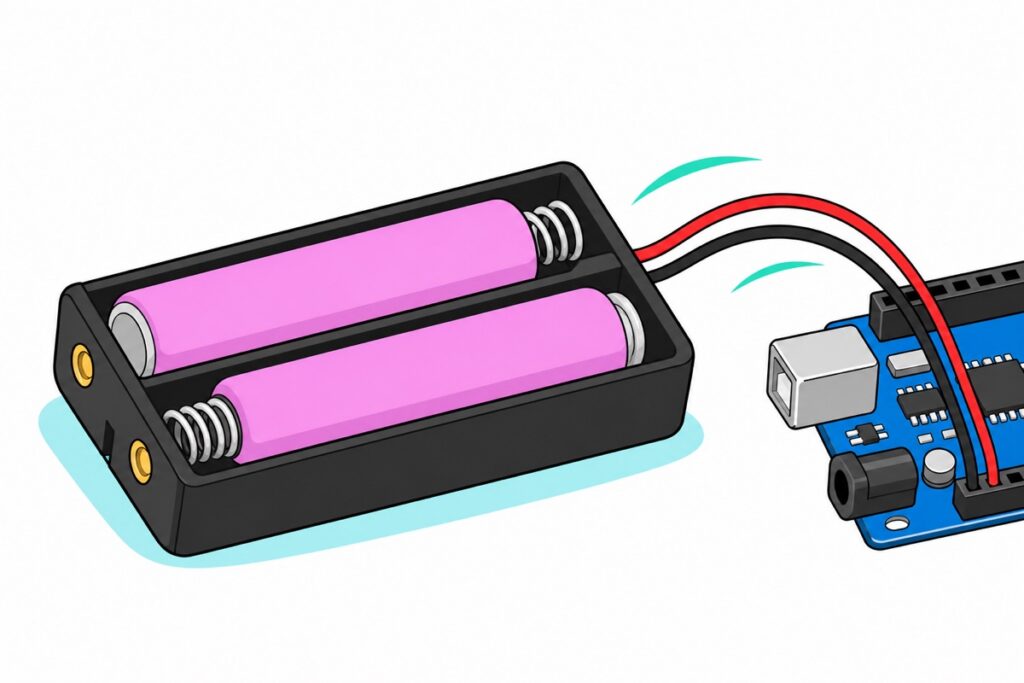
Without USB, an Arduino Uno or Nano takes power three ways: 7–12V into the barrel jack (Uno only) or the VIN pin, or only regulated 5V into the 5V pin. The best battery setup is two 18650 cells in series, a 7.4V pack, into VIN: red to VIN, black to GND, checked twice, because VIN has no reverse-polarity protection. A 9V PP3 is the worst common choice: around 500mAh, and nearly half its energy burned off as regulator heat.
Which power inputs does an Arduino Uno or Nano have?
The Arduino Uno offers three ways in besides its USB socket, and they are not interchangeable. The black barrel jack feeds a series protection diode and then the board’s 5V linear regulator — plug in a reversed supply and the diode simply blocks it. The VIN header pin joins the same path after that diode, so it reaches the regulator with no reverse protection at all. The 5V pin skips everything: it is the 5V rail itself, straight to the microcontroller. Arduino’s own spec for the jack and VIN is 7–12V.
The Arduino Nano has no barrel jack: its mini-USB socket, the VIN pin and the 5V pin are the only doors, and VIN runs straight into its regulator with the same no-protection caveat. Our Nano ships as a bare board with open pin holes and no headers in the box, so breadboard builds start with a 40-pin male header strip, snapped into two 15-pin rows and soldered in — our header soldering guide walks through it. After that, everything below applies to it too.
| Input | Accepts | Reverse protection | What sits behind it |
|---|---|---|---|
| Barrel jack (Uno only) | 7–12V DC, centre-positive | Yes — series diode | Diode, then the 5V regulator |
| VIN pin | 7–12V DC | None | The 5V regulator directly |
| 5V pin | Regulated 5V only — never a raw battery | None | The 5V rail itself, straight to the chip |
| USB socket | 5V from any USB source | Not needed — the plug only fits one way | The 5V rail, through a fuse (Uno) or a diode (Nano) |
Parts list: 2×18650 battery pack for the Uno (no soldering)
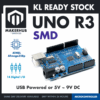 Arduino Uno Compatible SMD UNO R3 with Type B Cable - ATMEGA328P with CH340G-Microcontroller Project
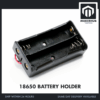 18650 Battery Holder 1/2/3/4 Slot 3.7V Battery Cell Housing Battery Case Battery Casing - 18650 BATTERY HOLDER (2)
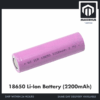 3.7V 18650 Battery Rechargeable Li-Ion Battery 1200mAh 2200mAh 3200mAh Flat Top - 18650 Li-Ion Battery (2200mAh)
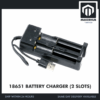 18650 Battery Charger 1/2 Slot Li-on Battery Charger USB A Connector 3.7V Universal Charger - 18651 BATTERY CHARGER (2 SLOT)
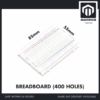 MB102 Breadboard 170 400 830 Holes Breadboard Donut Board Arduino Prototype Multi Color - BREADBOARD (400 HOLES)
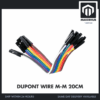 40pcs Dupont Wire 10cm 20cm 30cm for Breadboard DIY Experiment Jumper Wire Breadboard wire - DUPONT WIRE M-M 20CM
Parts list
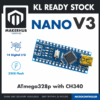 Arduino NANO Compatible NANO V3 - ATMEGA328P with C340G - Mini USB - Microcontroller Project
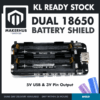 Dual 18650 Lithium Battery Holder Shield V3 Power Module 5V USB 3V Pin Output Charging
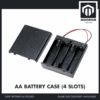 AA Battery Holder with Cover On/Off Switch 2/3/4 Slots Battery AA Holder Red/Black Wire - AA BATTERY CASE (4S)
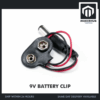 9V Battery Snap DC Plug 2.1mm Hard Case - 9V CLIP (WITH DC JACK)
The Nano itself, the all-in-one boost shield lane, the 4×AA case for the budget lane, and the 9V snap-to-plug for quick bench tests.
Why does the 5V regulator decide which battery works?
The 1117-class regulator on these boards is a linear regulator: an automatic resistor that burns off everything above 5V as heat. The same current flows in as out, so the wasted fraction is simply (input − 5V) ÷ input. At 9V in, that is 4V of 9 — about 44% of the battery’s energy lost as heat. At 12V, more than half. That is also why runtime is simply mAh ÷ mA: the regulator wastes voltage, not charge, and only a switching regulator (below) can turn that voltage back into extra current.
It also needs headroom. The AMS1117’s dropout is 1.1–1.3V, so a clean 5V needs about 6.3V at VIN — and roughly 0.7V more through the jack’s diode, which is where Arduino’s 7V floor comes from. Feed less and the rail follows the battery downward — the board browns out. The sweet spot is 7–9V: enough headroom to regulate, little enough heat tax. Two lithium cells at 7.4V nominal land exactly there, paying about a third in heat — the price of a dead-simple build; the boost shield below refuses to pay it.
Heat also caps current: everything on the 5V rail, 5V-pin loads included, flows through the regulator, whose small package sheds about 1W before its thermal protection cuts in. Since that heat is (input − 5V) × current, the limit arrives near 400mA from a 7.4V pack and near 150mA from 12V. Servos and motors need their own supply.
Every common setup, compared:
| Setup | Into | Voltage | Verdict |
|---|---|---|---|
| 2×18650 in series | VIN | 7.4V nominal (8.4V full, ~6V empty) | Best all-round — in the sweet spot, rechargeable, ~40 hours on a bare Uno |
| Dual-18650 boost shield | USB socket | Regulated 5V | Efficient and polarity-proof once the project draws real current; switch at HOLD for a bare board |
| USB power bank | USB socket | 5V | Easiest, but many banks auto-sleep on a bare board |
| 4×AA alkaline | VIN | 6V (6.4V fresh) | Marginal — browns out as the cells sag |
| 4×AA NiMH | VIN | 4.8V | Too low for VIN; fine for servos |
| 9V PP3 | Barrel jack | 9V | Bench tests only — ~500mAh, 44% lost as heat |
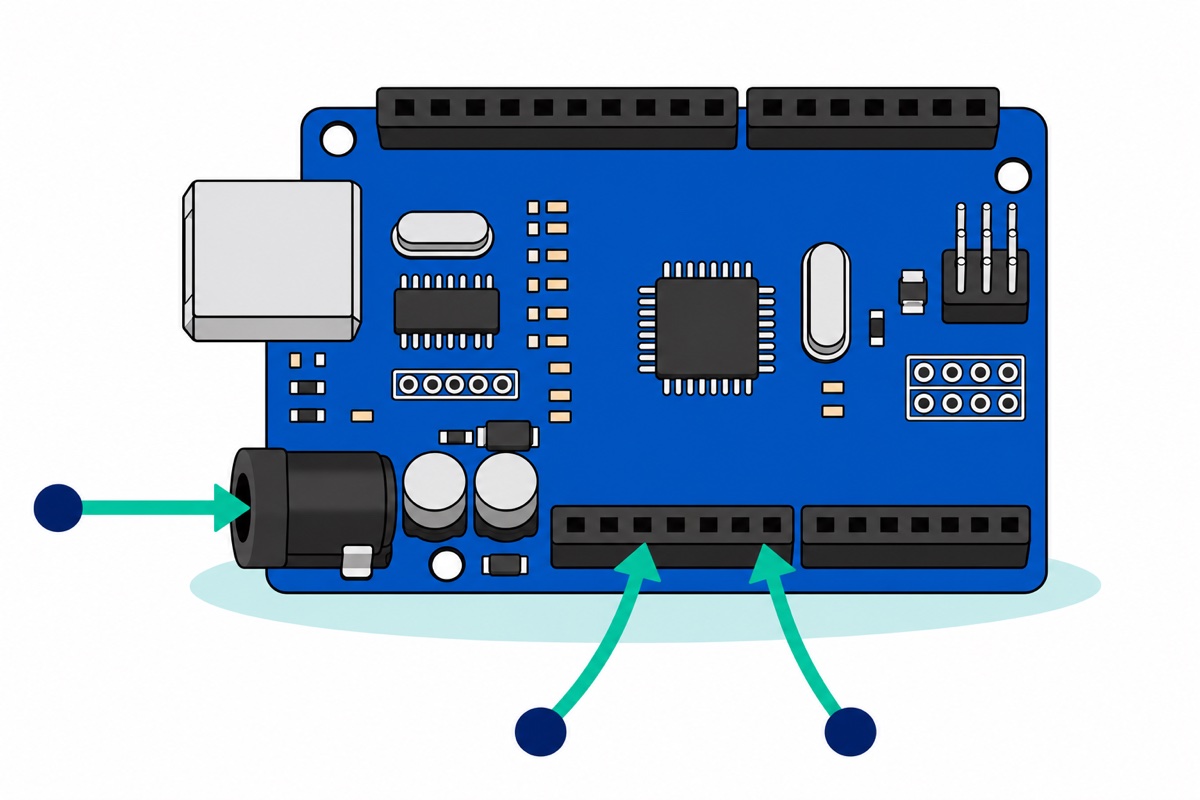
How do you build the 2×18650 battery pack?
The two-slot 18650 holder wires its slots in series: voltages add, capacity does not. Two 2200mAh 18650 cells therefore make a 7.4V-nominal, 2200mAh pack — 8.4V fresh off the charger, about 6V empty. The 3.7V moulded into the holder’s floor is the per-cell marking, not the pack output. A bare Uno draws roughly 50mA, so expect around 40 hours per charge, with the discharge curve inside the 7–9V sweet spot almost to the end. Our battery holder guide compares the other slot counts.
Assembly needs no soldering. The holder’s red and black leads end in thin bare-tinned tips: push each into its own row of the 400-point breadboard, then two male-to-male jumpers carry those rows up into the Uno’s female headers (for a Nano, the board itself sits on the breadboard and the jumpers go to its VIN and GND pins):
| From | Through | To |
|---|---|---|
| Holder RED lead | its own breadboard row + a red M-M jumper | Uno/Nano VIN |
| Holder BLACK lead | a second breadboard row + a dark M-M jumper | Uno/Nano GND |
On the Uno, VIN is the last POWER-header pin before A0; on the Nano, the corner pin farthest from the USB socket. Only two pins separate it from 5V, so count twice. Then check that red lands on VIN and black on GND: VIN sits past the protection diode, so a reversed pack drives current backwards through the regulator and the chips behind it — the board dies on contact. The red jumper doubles as your on/off switch, and it can stay in while you upload over USB: both boards pick their power source automatically.
Respect the cells. These are unprotected ICR lithium cells: nothing inside them, or in the holder, stops a short or a deep discharge. Charge them only in the two-slot USB charger, which limits the current and stops at exactly 4.2V per cell; the holder is just springs and wire, and “topping up” through its leads with a random supply can make a cell vent or catch fire. Charge both full first and always together — in series, the emptier cell over-drains while the pack still reads fine — and never carry loose cells against keys or coins. Don’t wait for the board to flag a flat pack: its brown-out reset waits until the 5V rail falls to about 2.7V, by which point each cell is far below its safe 3.0V. Measure the pack with a multimeter, recharge at about 6V, and pull a jumper whenever the project is idle. Our lithium battery guide covers handling in depth.
Is a boost shield or a power bank better than VIN?
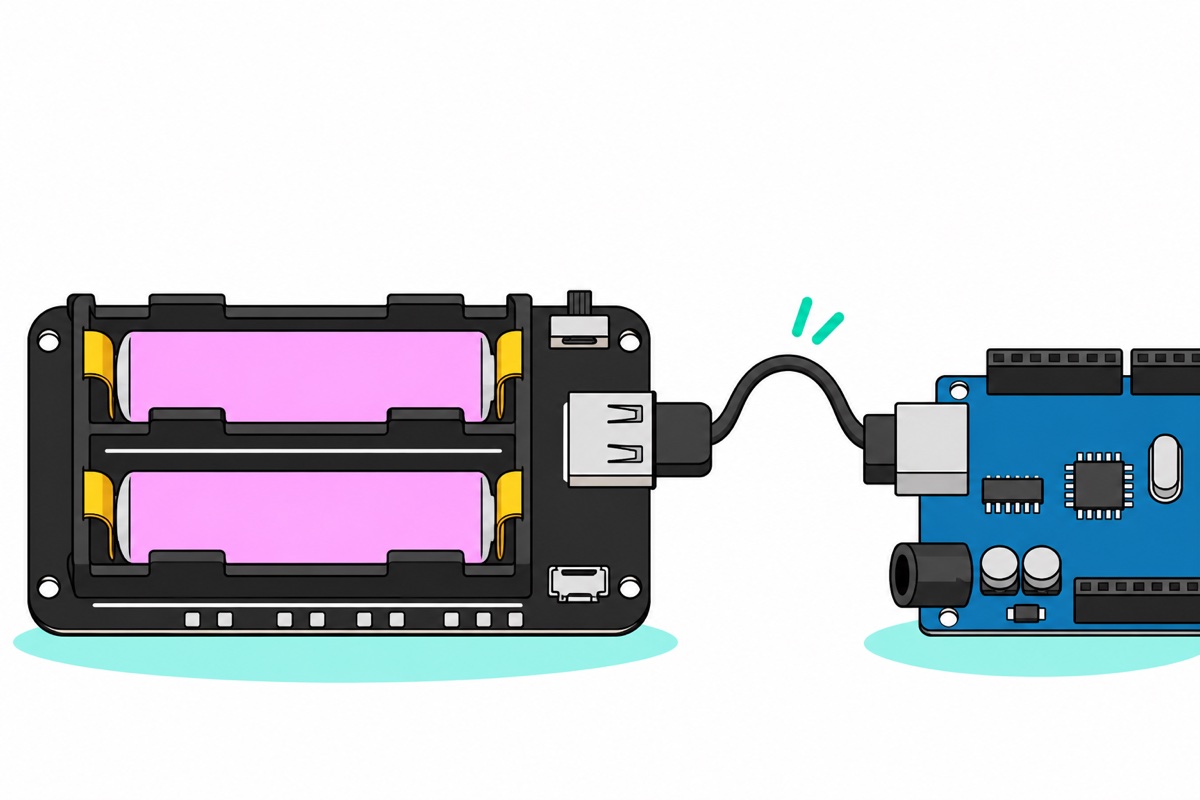
The dual-18650 battery shield replaces the holder, charger and jumpers with one board: the cells drop into its two bays, it recharges them in place through its micro-USB socket, and it serves regulated 5V from a USB-A socket — the Uno’s own Type-B cable (or a mini-USB cable for the Nano, which ships without one) plugs straight in through the protected USB door. Set its HOLD/NORMAL slide switch to HOLD: in NORMAL the shield acts like a power bank and cuts its output under a load as light as a bare Uno or Nano.
Three things differ from the series pack. First, the bays are in parallel: the shield boosts a single-cell 3.7–4.2V rail to 5V and recharges through one single-cell charger circuit, which only works with the cells side by side — so insert both at a matched charge level; a full and an empty cell in parallel dump current into each other. Second, the boost converter is a switching regulator: hundreds of thousands to over a million times a second it lets current build up in an inductor, then releases that stored energy at the higher voltage — trading current for voltage instead of burning the surplus, typically 85–90% efficient where the linear regulator throws a third away.
Third, the shield thinks it is a power bank: at NORMAL, a bare Uno or Nano can lose power within seconds. HOLD keeps the chip awake by adding a load of its own — current your cells pay for, which erodes the efficiency gain on a 50mA board. So the series pack stays the default for a bare board; the shield earns its keep once the project draws real current.
The advanced version: one 18650 in a one-slot holder feeding a bare MT3608 boost module into the 5V pin. The module ships with bare solder pads, and its output must be set to 5.0V with a multimeter before anything is connected — the 5V pin has no regulator to forgive a wrong setting. Never feed the 5V pin while USB is plugged in: on the Uno the pin ties straight to the rail the computer’s port drives, and backfeeding a port can damage it.
The cheapest portable Uno of all: a power bank you already own plus a USB-to-9V barrel cable into the jack. The cable boosts 5V to 9V and the board’s regulator burns the extra 4V, so the bank supplies about double the current — often enough to keep it awake. Wasteful on purpose, and the jack’s diode protection comes free.
Why is a 9V PP3 battery a poor choice?
A PP3 is six tiny 1.5V cells stacked in series inside one shell — built for smoke detectors sipping microamps for years, not for boards drawing tens of milliamps. An alkaline PP3 holds about 500mAh, and its six small cells stack up six internal resistances, so it sags hard whenever a servo or module draws a burst; the regulator then turns 44% of what survives into heat. Net: roughly 2.5Wh reaches your project, against about 11Wh from the two 18650s after their own one-third tax — over four times the runtime, and they recharge.
It keeps one honest job: quick bench tests. A 9V snap with a barrel plug clicks onto the battery and into the Uno’s jack — the protected door — and proves a sketch runs standalone in seconds. If the project never leaves the desk, skip batteries entirely: a 9V 2A adapter in the jack, sized with our DC power supply guide.
Can four AA batteries power an Uno or Nano?
A 4×AA case with switch gives 6V on alkalines — just under the 6.3V that VIN needs. A fresh pack reads near 6.4V unloaded, dips under load and sinks across its life, so the board works today and resets mysteriously next week. That is brown-out, not a bug in your sketch.
Four NiMH rechargeables make 4.8V — a volt and a half under the floor; the rail lands near 3.7V, below the roughly 3.8V the ATmega328P needs to run reliably at 16MHz, so the board limps or crashes and 5V sensors misread. AA packs are good hardware (the built-in switch is the tidiest on/off these builds get), but they belong on servos, on 3.3V boards like the ESP32 or behind a boost converter, not on a 5V board’s VIN. Our AA chemistry guide has the full curves.
Common mistakes we see
A battery pack wired to the 5V pin. 7.4V on the 5V rail is far beyond the ATmega328P’s 6V absolute maximum, so the board dies instantly. The 5V pin accepts only genuinely regulated 5V — a boost module’s measured output, never a raw battery of any voltage.
Servos on a 9V PP3, or on the board’s 5V pin. Each servo movement makes the PP3’s high internal resistance dip the voltage, the regulator loses headroom, and the board resets — it reads like a software bug. The 18650 pack cures the sag but not the heat: a stalling servo alone overruns the regulator’s 1W budget. Give servos their own supply (4×AA NiMH is the classic), sharing only GND with the Arduino.
Leaving the pack connected. The holder has no switch, so a forgotten board keeps drawing 50mA right past empty and deep-discharges the unprotected cells. Pull the red jumper when you stop.
FAQ
Can I power an Arduino Nano with a 9V battery?
It works — 9V is inside VIN’s 7–12V range — but with about 500mAh, a 44% regulator heat loss and heavy sag under servo loads, it suits only short bench tests. Anything running longer than an evening deserves the 2×18650 pack or the boost shield.
What voltage does the Arduino Nano VIN pin accept?
Arduino recommends 7–12V DC. Physically, VIN needs about 6.3V — 5V plus the regulator’s 1.1–1.3V dropout — to hold a clean 5V, so 7V leaves margin for a sagging battery. Above 12V, over half the energy becomes heat. VIN has no reverse-polarity protection: double-check red on VIN, black on GND.
Can I run an Uno or Nano from a USB power bank?
Yes — the board’s normal USB cable into a power bank is the simplest battery power there is. The catch: many banks switch off when the load looks too small, and a bare board sits near that line. The USB-to-9V cable into the jack roughly doubles the draw, which keeps many banks awake; the dual-18650 shield stays on with its switch at HOLD.
Can I connect a single 3.7V 18650 directly to the board?
No. 3.7V is far below what VIN needs, and on the 5V pin the cell’s unregulated 4.2V sinks to 3.0V as it drains — under the roughly 3.8V the ATmega328P needs at 16MHz. A single cell needs a boost stage: the dual-18650 shield ready-made, or an MT3608 module set to 5.0V before first connection.
How long will two 18650 cells run an Arduino Uno?
Series wiring adds voltage, not capacity, so the pack is 2200mAh at 7.4V — about 16Wh. A bare Uno drawing roughly 50mA runs around 40 hours; with sensors or motors attached, divide 2200mAh by your measured current instead. For builds that run outdoors indefinitely, see our solar power guide.
Last updated November 2026. Stuck? Chat with us on WhatsApp.
