

Tutorials
Which Battery Holder? 18650 vs AA, Slots and Switch
Oct
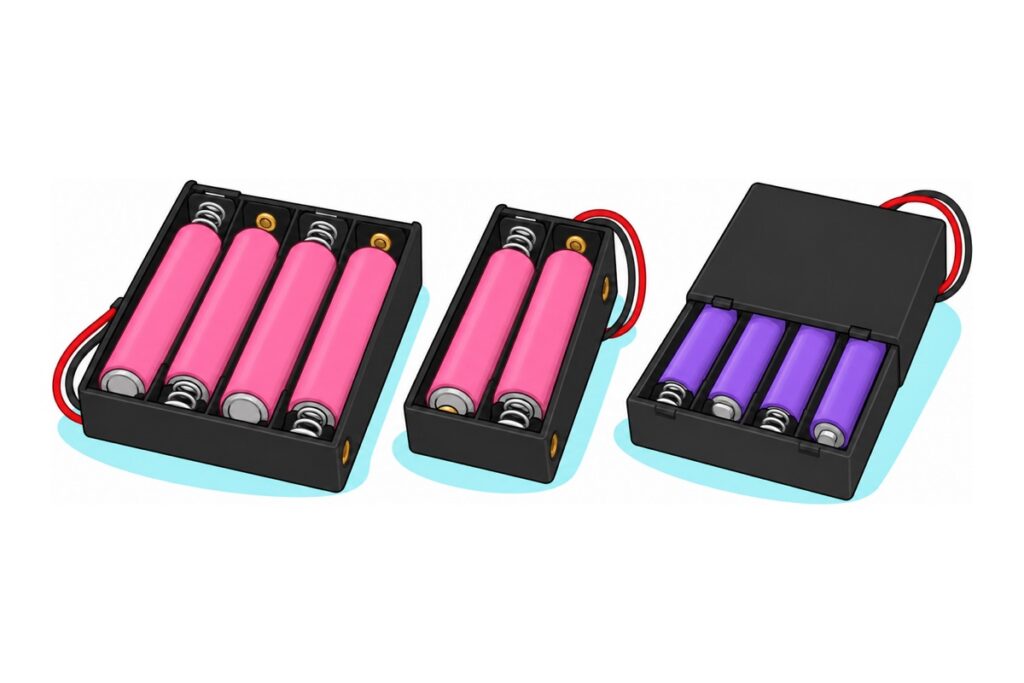
Choose a battery holder by the voltage your project needs, not by how many cells it takes. The slots in our 18650 and AA holders are wired in series, so each extra cell adds volts, not run time: four NiMH AAs give 4.8 V for servos, two 18650s give 7.4 V for an Arduino Uno’s barrel jack. Then make sure every cell is actually touching its contacts.
Shops also call it a battery case, battery casing or cell holder; in Malay it is a bekas bateri or pemegang bateri. It sits between the cell (which to buy: lithium battery types) and the charger (charging a 3S 18650 pack), and it often fails first:
“Saya dah cas battery 18650 lebih dari 5 jam. Tapi tetap tidak menyala… Guna direct wayar dan battery AA menyala.” (I charged the 18650s for over 5 hours and it still won’t light. With direct wires and AAs, it lights.) The AA holder proves the board works, and the cells are probably fine too: a series holder outputs nothing if one contact is open, as the check below shows.
What does each extra slot in a battery holder do to the voltage?
Each slot in a series battery holder adds one cell’s voltage and no capacity. Current leaves one cell’s positive end and enters the next cell’s negative end, so the voltages stack like steps. The same current flows through every cell, so the mAh stays at one cell’s rating.
You can see the series wiring on the holder itself: the moulded + and − marks on our 18650 trays swap ends from channel to channel, so the cells form that positive-to-negative chain, and only its two ends get a lead. A meter settles it: two charged cells read about 8 V across a series holder’s leads, 4 V across a parallel one. The “3.7V” moulded into the tray is per cell, not the holder’s voltage.
| Holder | Cells in series | Nominal | Fresh / full | Near empty |
|---|---|---|---|---|
| 18650, 1 slot | 1 × 18650 Li-ion | 3.7 V | 4.2 V | 3.0 V |
| 18650, 2 slots | 2 × 18650 | 7.4 V | 8.4 V | 6.0 V |
| 18650, 3 slots | 3 × 18650 | 11.1 V | 12.6 V | 9.0 V |
| 18650, 4 slots | 4 × 18650 | 14.8 V | 16.8 V | 12.0 V |
| AA with cover, 2 slots | 2 × AA | 3.0 V alkaline / 2.4 V NiMH | about 3.2 V / 2.8 V | 2.0 V |
| AA with cover, 3 slots | 3 × AA | 4.5 V / 3.6 V | about 4.8 V / 4.2 V | 3.0 V |
| AA with cover, 4 slots | 4 × AA | 6.0 V / 4.8 V | about 6.4 V / 5.6 V | 4.0 V |
Every row is cells × volts per cell: Li-ion 3.7 V nominal and 4.2 V full, alkaline 1.5 V (about 1.6 V fresh), NiMH 1.2 V (about 1.4 V off the charger), any AA about 1.0 V when nearly flat. Why the two AA chemistries differ under load is in the NiMH vs alkaline guide.
What sizes do the 18650 and AA battery holders come in?
Pick ONE holder: the one whose voltage your project needs
 18650 Battery Holder 1/2/3/4 Slot 3.7V Battery Cell Housing Battery Case Battery Casing - 18650 BATTERY HOLDER (1)
 18650 Battery Holder 1/2/3/4 Slot 3.7V Battery Cell Housing Battery Case Battery Casing - 18650 BATTERY HOLDER (2)
 18650 Battery Holder 1/2/3/4 Slot 3.7V Battery Cell Housing Battery Case Battery Casing - 18650 BATTERY HOLDER (3)
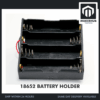 18650 Battery Holder 1/2/3/4 Slot 3.7V Battery Cell Housing Battery Case Battery Casing - 18650 BATTERY HOLDER (4)
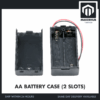 AA Battery Holder with Cover On/Off Switch 2/3/4 Slots Battery AA Holder Red/Black Wire - AA BATTERY CASE (2S)
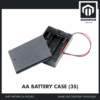 AA Battery Holder with Cover On/Off Switch 2/3/4 Slots Battery AA Holder Red/Black Wire - AA BATTERY CASE (3S)
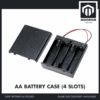 AA Battery Holder with Cover On/Off Switch 2/3/4 Slots Battery AA Holder Red/Black Wire - AA BATTERY CASE (4S)
Parts list
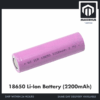 3.7V 18650 Battery Rechargeable Li-Ion Battery 1200mAh 2200mAh 3200mAh Flat Top - 18650 Li-Ion Battery (2200mAh)
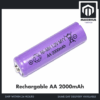 Rechargeable AA Battery 1.2V NiMH High Capacity 2000mAh-3000mAh Long Life Battery for Electronics DIY Projects - RECHARGEABLE AA 2000mAh
The cells that go in the holders, one per slot. Our 18650s are flat-top and seat properly in these spring trays. Our rechargeable AAs are NiMH at 1.2 V, not 1.5 V, so four of them make 4.8 V. In a series holder, use cells from the same batch at the same charge.
Why does the voltage, not the slot count, decide whether your project works?
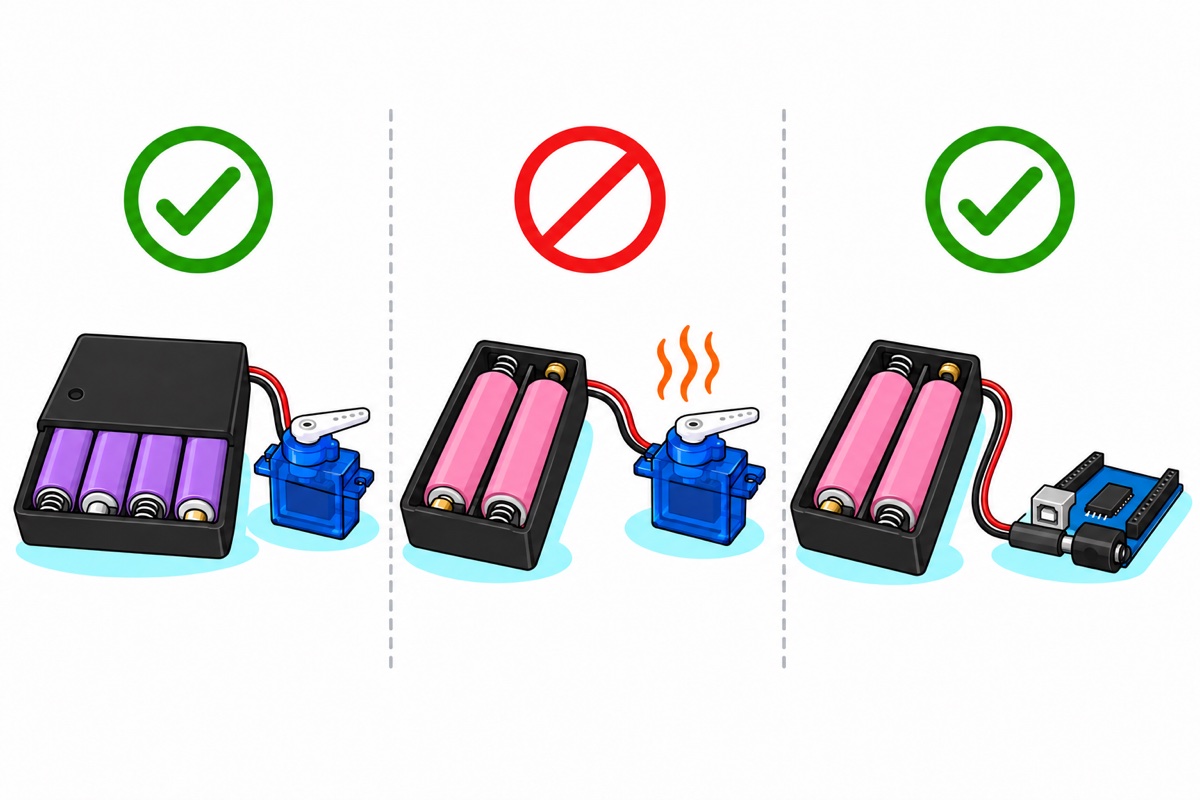
Most small hobby servos are rated 4.8 to 6 V. Four NiMH AAs in the 4-slot AA case make 4.8 V, about 5.6 V off the charger, inside that range: the classic servo pack. A servo has no regulator, so a 2-slot 18650 holder’s 8.4 V reaches its chip and motor directly and overheats them. Join the pack’s black lead to the Arduino’s GND too: the signal needs that shared reference, or the servo jitters.
An Arduino Uno’s barrel jack needs more voltage, not less. The Uno R3 datasheet lists a 4007 rectifier diode and a 1117 5 V regulator, and the Uno R3 schematic puts both after the jack: the diode drops about 0.8 V, then the regulator needs about 1.1 V more in than it puts out. So 5 + 1.1 + 0.8 means about 7 V before the 5 V rail holds. Four alkaline AAs (6.0 V, falling) leave the rail near 4 V and sinking, so readings drift and the board can reset. A 2-slot 18650 holder stays above 7 V for most of its charge. A 3-slot works, but at 12.6 V full it is past the top of Arduino’s recommended 7–12 V, and the diode and regulator burn the excess as heat: the regulator alone takes (12.6 − 0.8 − 5) V × 0.2 A, about 1.4 W, in a part smaller than a fingernail.
Our holders have bare leads: fit a 2.1 mm centre-positive DC plug (red to the centre pin) for the jack, or wire red to VIN, black to GND. A plug wired the other way leaves the board dark: the diode blocks it. VIN sits after that diode, so a reversed lead there reaches the regulator unprotected and can destroy the board. For a clean 5 V (ESP32, USB, 5 V logic), use one cell with a boost converter, or the dual-18650 shield, which boosts two parallel cells to 5 V (powering ESP32 projects).
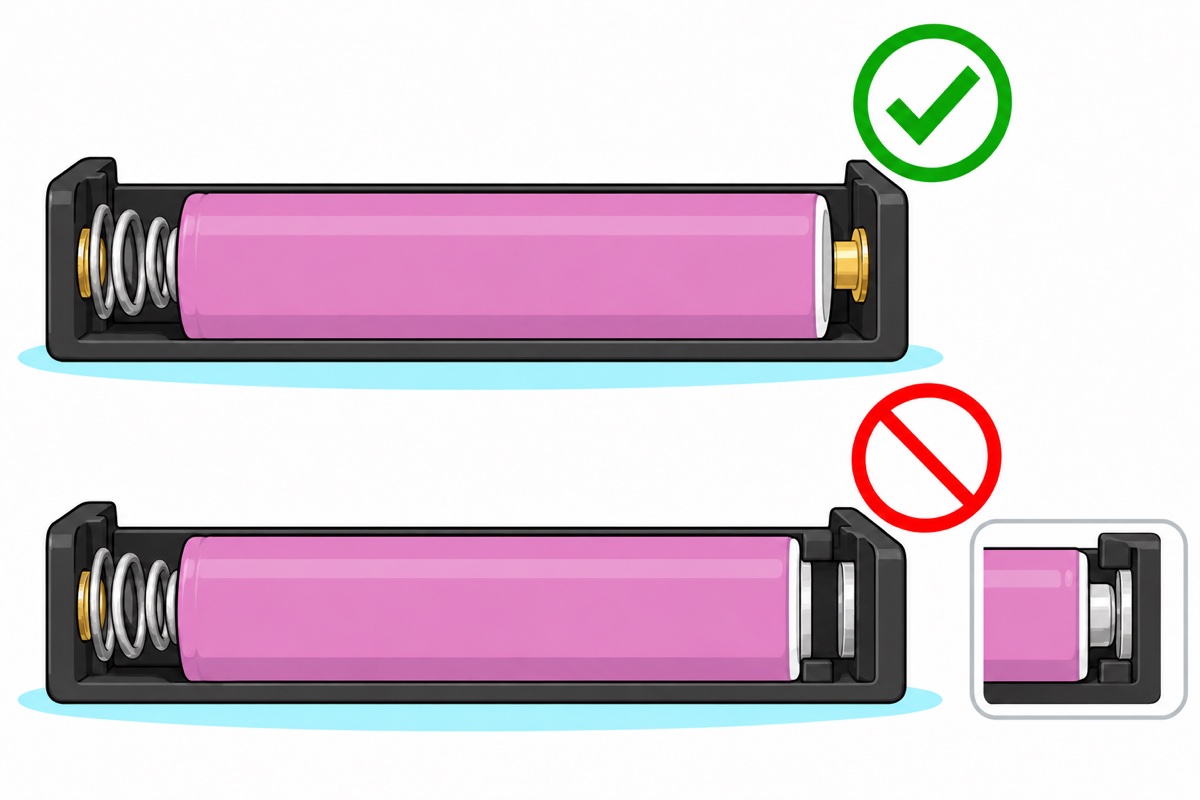
Why does a flat-top 18650 sometimes not seat in a holder?
A battery holder only works while something presses each cell against both contacts. In our 18650 trays a nickel-plated coil spring does that at the negative end, taking up small differences in cell length; the positive end is a rigid brass stud standing out from the end wall. The spring pushes the flat positive cap onto that raised stud, so our flat-top 18650 cells seat properly. The AA cases pair coil springs with flat plates, fine for AAs, which all have a raised positive button.
Flat-tops fail in holders whose positive contact is a flat plate set behind a moulded rib, often so a reversed cell cannot touch. A flat-top’s cap barely stands above the wrapper’s shoulder, so the shoulder hits the rib before the cap reaches the plate; a button-top’s raised nub reaches past it. Protected cells add a few millimetres to the standard 65 mm, which can squeeze a spring flat or stop the cell fitting.
Why buy a battery holder with the wires already attached?
Both our holder families come with red and black leads fitted, which saves a beginner a hard joint. The contact tab is nickel-plated steel, which solder wets far less readily than copper, so it needs more heat and flux. That heat runs into the spring and the plastic around the rivet, which softens long before a 330 °C iron finishes the joint; a spring that shifts then sits tilted and contacts poorly for good. Never solder to the cell itself: the long heating a steel end needs can cook a lithium cell’s seal and separator, which is why packs are spot-welded instead.
When is the AA battery holder with cover and switch worth it?
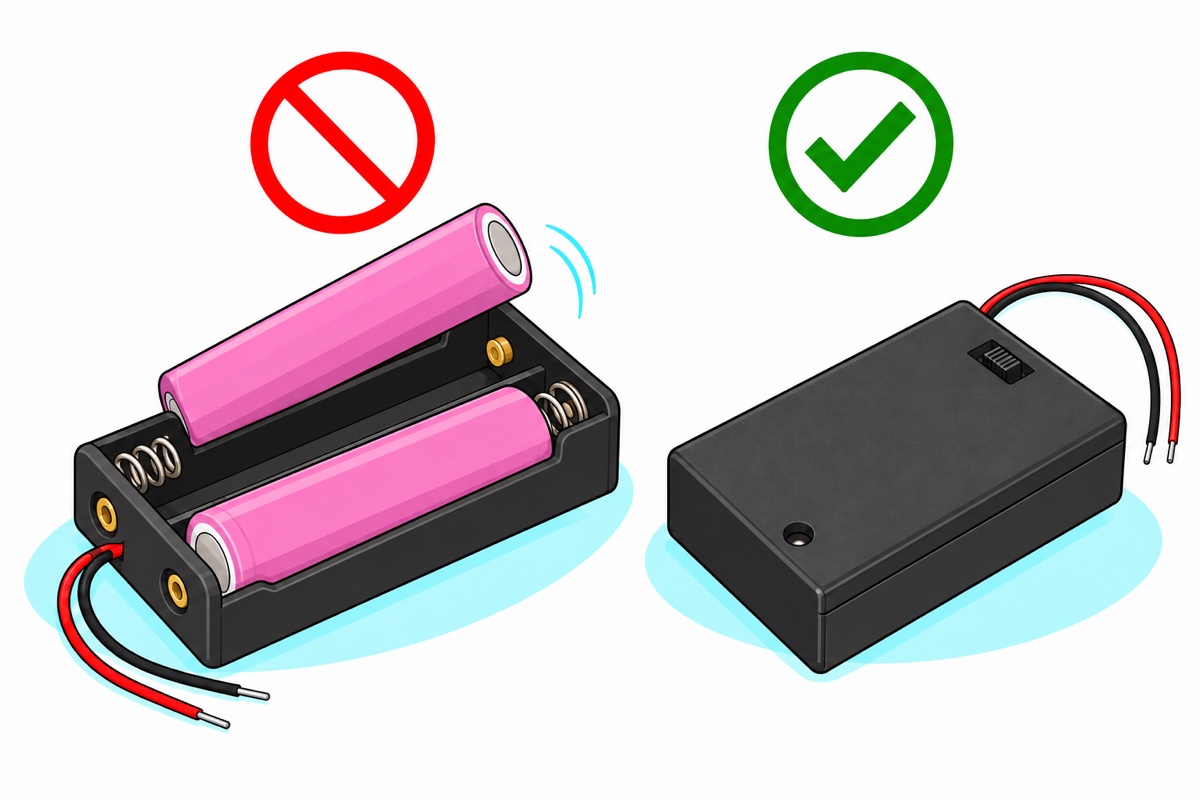
The covered AA case earns its place in anything that travels, like a school project in a bag. On an open tray the springs push outward on the cells, so one knock can pop a cell out and the project arrives dead. The lid holds every cell and keeps loose metal off the contacts; the on/off switch breaks the series loop, so the cells stop draining between lessons. On a bench, an open tray is fine.
⚠️ A 14500 cell is AA-sized but 3.7 V lithium. Four in an AA case make 14.8 V, enough to destroy anything built for 4.8–6 V.
⚠️ Never carry a loaded open 18650 tray loose in a bag: a key across two contacts can draw tens of amps from the cells and get hot enough to burn. Unload it or box it.
Why does my 18650 battery holder not light up when the cells are charged?
A 2-slot 18650 holder is one loop through four contacts and two cells. One open contact stops current in the whole loop, so the leads read 0 V even with full cells. A cell in backwards subtracts instead of adding: 3.7 − 3.7 is about 0 V. With your meter on DC volts:
- Measure across the red and black leads with the cells in, and compare with the table below.
- At 0 V, check each cell against the moulded marks: the second cell faces the opposite way from the first.
- Press each cell down into its channel and toward its brass stud while watching the meter. If the reading jumps, that contact is the fault: clean the stud and spring with isopropyl alcohol on a cotton bud, and gently stretch a sagged spring.
- Measure each cell across its own ends: about 4.1–4.2 V after charging is a good cell.
| Reading at the 2-slot holder’s leads | Most likely cause |
|---|---|
| 7.4–8.4 V | Contacts pass the meter’s tiny current. If the project still cuts out, measure with it running: a reading that sags or flickers is a weak contact |
| About 0 V, jumps when you press a cell | That cell is not seated, or its contact is dirty |
| About 0 V, both cells read 3.7–4.2 V on their own | One cell is in backwards |
| About 0 V, one cell reads 0 V on its own | That cell is open circuit. If it is a protected cell (longer than 65 mm), it has cut itself off and a charger usually wakes it; a standard 65 mm cell with no protection board reading 0 V is dead: recycle it, do not charge it |
| About 3.7–4.2 V | One cell has been run down to near 0 V but still conducts, so only the other shows. If it reads below about 1.5 V on its own, recycle it rather than recharge it: a lithium cell drained that far can short inside when recharged |
Also check how they were charged. A single-cell TP4056 charger holds its output at 4.2 V, and charge only flows from higher to lower voltage; two cells in series already sit at 6 V or more, so across a 2-slot holder it pushes nothing in, however long it is plugged in. Charge cells one at a time (TP4056 guide) or use a 2S charging board.
Can a series 18650 holder run an RC car or a 12 V device?
The 3-slot 18650 holder is 12 V only when full. One customer asked: “2s 7.4v for two slot and 3s 12v for 3slot … make a 12v battery for my rc. Just plug and play?” Three slots are 11.1 V nominal, 12.6 V full, 9 V empty. He followed up: “What if i dont use the 3s bms?? I just charge the battery with exterior charger”. Charging cells separately starts them balanced, but nothing in a holder stops a weaker cell being driven too low while the others push current through it, or cuts off a short. Use matched cells from one batch and stop at about 3.3 V per cell (9.9 V for 3S); an ESC’s low-voltage cutoff can enforce that.
He also raised spring-type holders heating up compared with pin-type contacts. A coil spring is a long, thin steel wire, so spring contacts often measure tens of milliohms; call it 0.05 Ω each. Heat is current squared times resistance: at an Arduino’s 0.2 A, 0.04 × 0.05 = 0.002 W per contact, nothing. At an RC motor’s 10 A, 100 × 0.05 = 5 W in each small spring, enough to soften the plastic around it, and the six contacts of a 3S holder (6 × 0.05 = 0.3 Ω) drop 10 × 0.3 = 3 V. A pin contact skips the coil and runs cooler, but any pressed contact adds resistance: prototype on the bench in a holder, then drive the car on a spot-welded pack with a BMS (3S pack charging and BMS).
Which battery holder should you buy for your project?
| Project | Holder | Cells | Voltage | Why |
|---|---|---|---|---|
| Servo project, robot arm | AA case, 4 slots | 4 × NiMH AA | 4.8 V (5.6 V fresh) | Inside the 4.8–6 V servo range; four fresh alkalines start near 6.4 V, just over it, so use NiMH |
| Arduino Uno through the jack or VIN | 18650, 2 slots | 2 × 18650 | 7.4 V (8.4 V full) | Clears the regulator’s roughly 7 V minimum. The open tray has no switch: add a power switch |
| Robot car with an L298N driver | 18650, 2 slots | 2 × 18650 | 7.4 V | The L298N drops around 2 V, leaving about 5 V at the motors |
| ESP32, 5 V logic, USB devices | 18650, 1 slot + charger + boost, or the dual-18650 shield | 1 × 18650 (or 2 in parallel) | 3.7 V boosted to 5 V | A single-cell rail charges from a single-cell charger |
| School project carried in a bag | AA case, 2 or 3 slots | 2–3 × AA | 3.0 / 4.5 V alkaline | Lid keeps the cells in; switch stops the drain. Below an Uno’s 7 V: an Uno travels on a 2-slot 18650 tray inside a closed box |
| 12 V LED strip, small 12 V device | 18650, 3 slots | 3 × 18650 | 11.1 V (12.6 V full) | “12 V” only when full; use matched cells |
| Solar-powered Arduino or ESP32 | 18650, 1 slot | 1 × 18650 | 3.7 V boosted to 5 V | The panel feeds a single-cell charger, so one cell: see solar power with an 18650 |
| High-current RC | 3 or 4 slots for bench tests only | 3–4 × 18650 | 11.1 / 14.8 V | Use a spot-welded pack with a BMS for the real thing |
Common mistakes we see from real customers
“Hi. I nak beli battery untuk power the arduino. Battery mana yang I patut beli?” (I want a battery to power the Arduino. Which should I buy?) The battery comes second; first find the board’s voltage, then pick its row in the table above: a 2-slot 18650 holder for an Uno.
“Hi, yg ni brapa volt? Maksud ya nk kena guna brapa battery?” (How many volts is this? I mean, how many batteries do I need?) Divide the voltage your board or motor needs by the cell voltage: 7.4 V ÷ 3.7 V is two 18650 slots, 4.8 V ÷ 1.2 V is four NiMH AAs.
“kejap, bateri tu nak letak mana ya? sebab di dalam video tiada menggunakan bateri” (Wait, where does the battery go? The video doesn’t use one.) Most videos power the board from the laptop’s USB. Away from it, the cells go in a holder whose leads feed the board’s power input.
FAQ
What is a battery holder called in Malay?
Bekas bateri or pemegang bateri.
Are the slots in an 18650 battery holder in series or parallel?
Ours are in series (the polarity marks alternate from channel to channel), so two slots give 7.4 V nominal.
Which battery holder do I need for an Arduino Uno?
A 2-slot 18650 holder (7.4 V, 8.4 V full) into the barrel jack or VIN. Four alkaline AAs give about 6 V, below the roughly 7 V the jack needs.
Can flat-top 18650 batteries go in a battery holder?
Yes, in spring-and-raised-stud trays like ours. Recessed-plate holders need button-tops.
Do I need a battery holder with a switch?
For anything carried in a bag or left between uses, yes: the lid holds the cells and the switch stops the drain.
Last updated October 2026. Stuck? Chat with us on WhatsApp.
