

Tutorials
NiMH vs Alkaline AA: What Your Project Actually Gets
Aug
Four AA cells are not one voltage. Four fresh alkalines make about 6.4 V; four charged NiMH cells make about 5.6 V and settle at 4.8 V. Whether your servo runs, whether a 5 V rail holds, whether the Uno’s barrel jack works at all — every one of those answers follows from that gap.
What voltage does a four-cell AA pack actually put out?
The number printed on an AA cell is its nominal voltage — the flat middle of its discharge, not its full range. Energizer’s E91 alkaline datasheet gives 1.5 V nominal, and a new alkaline reads nearer 1.6 V open-circuit. Panasonic’s Ni-MH handbook gives 1.2 V nominal, calls the discharge flat at 1.2 V, and sets the empty point at 1.0 V per cell — while a cell straight off the charger sits nearer 1.4 V.
An AA battery holder wires its slots in series, so pack voltage is one cell multiplied by the slot count while the current capability stays that of a single cell. A 2-slot, 3-slot or 4-slot AA battery holder is the same plastic and the same contacts; the slot count sets your voltage and the chemistry you drop in sets the rest.
| Pack | Full (off charger / brand new) | Nominal | Near-empty (1.0 V per cell) |
|---|---|---|---|
| 2 × NiMH | 2.8 V | 2.4 V | 2.0 V |
| 3 × NiMH | 4.2 V | 3.6 V | 3.0 V |
| 4 × NiMH | 5.6 V | 4.8 V | 4.0 V |
| 2 × alkaline | 3.2 V | 3.0 V | 2.0 V |
| 3 × alkaline | 4.8 V | 4.5 V | 3.0 V |
| 4 × alkaline | 6.4 V | 6.0 V | 4.0 V |
Both chemistries finish in the same place. What differs is the top of the range and the shape of the journey between — and that shape decides your build.
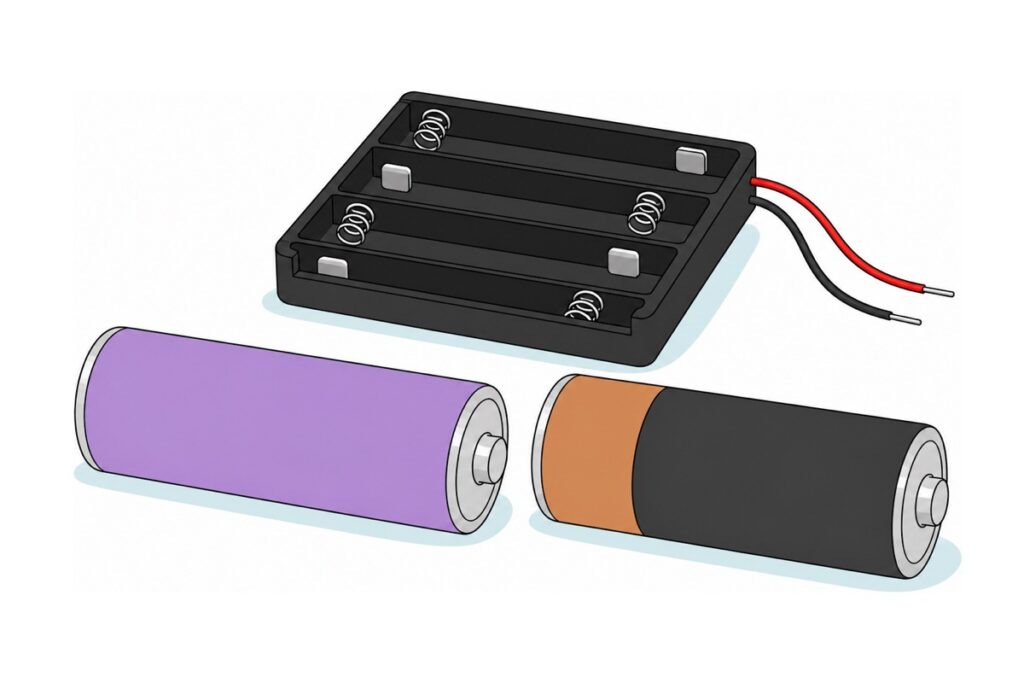
One check before any of that. The holder’s bays alternate direction, because series wiring runs positive to negative down the chain — so each cell’s button top must meet the flat metal tab and its base the coil spring, bay by bay, never all four facing the same way. Get one cell backwards and you lose two, not one: the reversed cell subtracts instead of adding, so four NiMH read 2.4 V and four alkalines 3.0 V. A pack measuring about half the table value has a cell in backwards, and the other three are pushing current the wrong way through it.
Parts list — running a project off AA cells
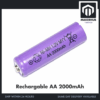 Rechargeable AA Battery 1.2V NiMH High Capacity 2000mAh-3000mAh Long Life Battery for Electronics DIY Projects - RECHARGEABLE AA 2000mAh
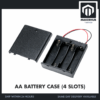 AA Battery Holder with Cover On/Off Switch 2/3/4 Slots Battery AA Holder Red/Black Wire - AA BATTERY CASE (4S)
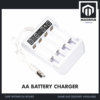 Rechargeable AA Battery 1.2V NiMH High Capacity 2000mAh-3000mAh Long Life Battery for Electronics DIY Projects - AA BATTERY CHARGER
Optional — the regulated 5 V lane
 USB C Boost Converter DC-DC Step Up Adjustable Output Module 3V-6V to 5V-28V HW-183Bd
 AA Battery Holder with Cover On/Off Switch 2/3/4 Slots Battery AA Holder Red/Black Wire - AA BATTERY CASE (3S)
Three cells instead of four, stepped up to a real 5 V. The 3-slot holder keeps the pack under the converter's setpoint so the board is always boosting and always regulating, which four cells would not. Both the converter's input and its output are bare plated pads, so bring a soldering iron.
Which of my parts care about 4.8 V versus 6.0 V?
The four-slot AA case wires cells straight to your load with nothing in between, so judge each part against the pack’s whole range, not its nominal number. Read the NiMH column knowing that 5.6 V is surface charge: Panasonic’s discharge curves show a cell leaving 1.4 V for its 1.2 V plateau inside the first few percent of a discharge, so a 5 V part really sees about 5.0–5.2 V.
Nothing in between also means no fuse, and the leads leave the holder as bare tinned wire. A charged NiMH pack has so little internal resistance that a shorted lead pulls tens of amps until the wire or a cell gives way. Fit the cells last, once the wiring is done, and sleeve any lead end you are not using. Rechargeables deserve more care here than alkalines, not less: an alkaline pack’s own resistance limits the damage, and a NiMH pack’s does not.
| Load | Wants | 4 × NiMH (5.6 → 4.0 V) | 4 × alkaline (6.4 → 4.0 V) |
|---|---|---|---|
| SG90-class hobby servo | 4.8–6.0 V | Dead centre for most of the pack’s life | Over its rating when new, correct in the middle |
| 5 V sensor or module rail | ≈4.5–5.5 V | Direct, until the pack falls under 4.5 V | Needs a regulator — 6.4 V is out of range |
| Uno / Nano 5V pin | 4.5–5.5 V | Workable, USB unplugged | Never — 6.4 V exceeds the chip’s 6.0 V limit |
| Uno DC jack or VIN pin | 6 V minimum at the VIN pin | Never, from the first minute | Never through the jack; VIN pin only above ~6.1 V |
That last row is a “no” for both. The Uno R3 regulates VIN with an SPX1117 linear regulator whose dropout is 1.1 V at full load, so it needs about 6.1 V at the VIN pin to hold 5 V out — which is why Arduino’s Uno R3 datasheet puts the VIN minimum at 6 V. The barrel jack is worse still: the board’s own schematic runs it through a series M7 rectifier before VIN, costing roughly another 0.8 V, so even four brand-new alkalines at 6.4 V never clear the jack. Four NiMH cells clear neither route — 5.6 V off the charger is already under the VIN pin’s own minimum. Four alkalines can feed the VIN pin for a while, then cross it with no warning: the 5 V rail just follows the input down until the board browns out mid-project.
The Uno’s 5V pin is the far side of that same regulator, which is why it works where the jack does not — and why it carries two rules. Nothing guards it: no reverse-polarity diode, no regulator downstream, so red and black swapped on those bare leads go straight into the microcontroller. And never feed it with USB plugged in — the pack then meets the board’s own 5 V supply and back-feeds the host port through the board’s resettable fuse. Pack or USB, one at a time; if you need the Serial Monitor while the pack runs the project, put a separate USB-serial adapter on RX and TX.
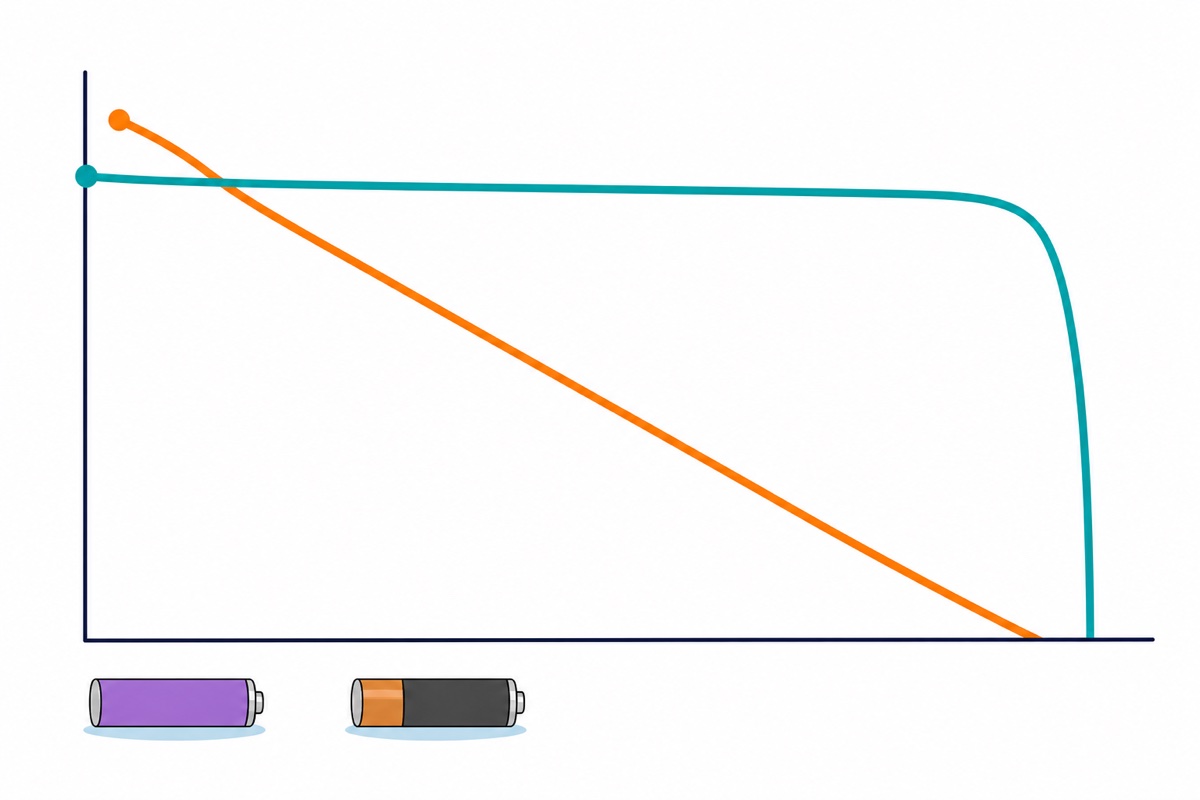
Why does alkaline sag under load while NiMH holds its line?
An alkaline AA’s internal resistance is the reason, and Energizer states it on the E91 sheet: 150 to 300 mΩ when fresh. A NiMH AA is around 25 mΩ. Four in series makes 0.6–1.2 Ω against roughly 0.1 Ω, so 500 mA costs the alkaline pack 0.3–0.6 V inside the cells before your circuit sees any of it, and the NiMH pack about 0.05 V. Worse, alkaline’s resistance climbs as the cell discharges, so the sag deepens when the pack is already low.
Capacity follows the same mechanism. The E91 capacity chart, measured to 0.8 V per cell at 21 °C, gives about 3,050 mAh at a 25 mA drain and about 1,530 mAh at 500 mA — and the missing half is not burnt off as heat. It is stranded: the cell’s own resistance drags its terminal voltage to the cutoff while much of the chemistry inside is still unreacted. And 0.8 V per cell means a 3.2 V pack, long after your 5 V project stopped, so the usable share is smaller again. The NiMH cell’s 2,000 mAh is rated to 1.0 V and it holds the plateau while delivering it — which is how it outlasts a nominally larger alkaline pack in anything with a motor.
If you would rather watch the curves than read them off a table, AKIO TV compares the three common AA-size chemistries:
Do I need a regulator, a boost converter, or neither?
A boost converter cannot regulate below its own input, and that one rule decides the design. Inside the HW-183B module a switch charges an inductor and dumps it through a Schottky diode into the output capacitor; when the setpoint is already below the input, the feedback pin sits high, the switch stops working, and the input flows straight through inductor and diode to the output, arriving about a third of a volt lower and unregulated. Four charged NiMH cells at 5.6 V into a converter set for 5 V therefore give roughly 5.25 V that tracks the pack down — not a 5 V rail.
The fix is fewer cells. Three NiMH cells in a 3-slot holder run 4.2 V down to 3.0 V: inside the module’s stated 3–6 V input window all the way and always below 5 V, so it is always boosting and in control. Four cells is the direct lane, not the boosted one — our boost versus buck guide covers the general choice.
Four alkalines have no clean answer here, and it is worth saying so plainly. That pack starts at 6.4 V and ends near 4.0 V, so it sits above a 5 V rail for the first part of its life and below it for the rest: a boost cannot pull the fresh end down, a buck cannot lift the tired end up, and only a buck-boost converter handles both. What does work is three alkalines — 4.8 V falling to 3.0 V, always under the setpoint, the same recipe as the NiMH one — or four NiMH cells straight to the 5V pin with no converter at all. For a steady 5 V rail that is the strongest practical argument for the rechargeables.
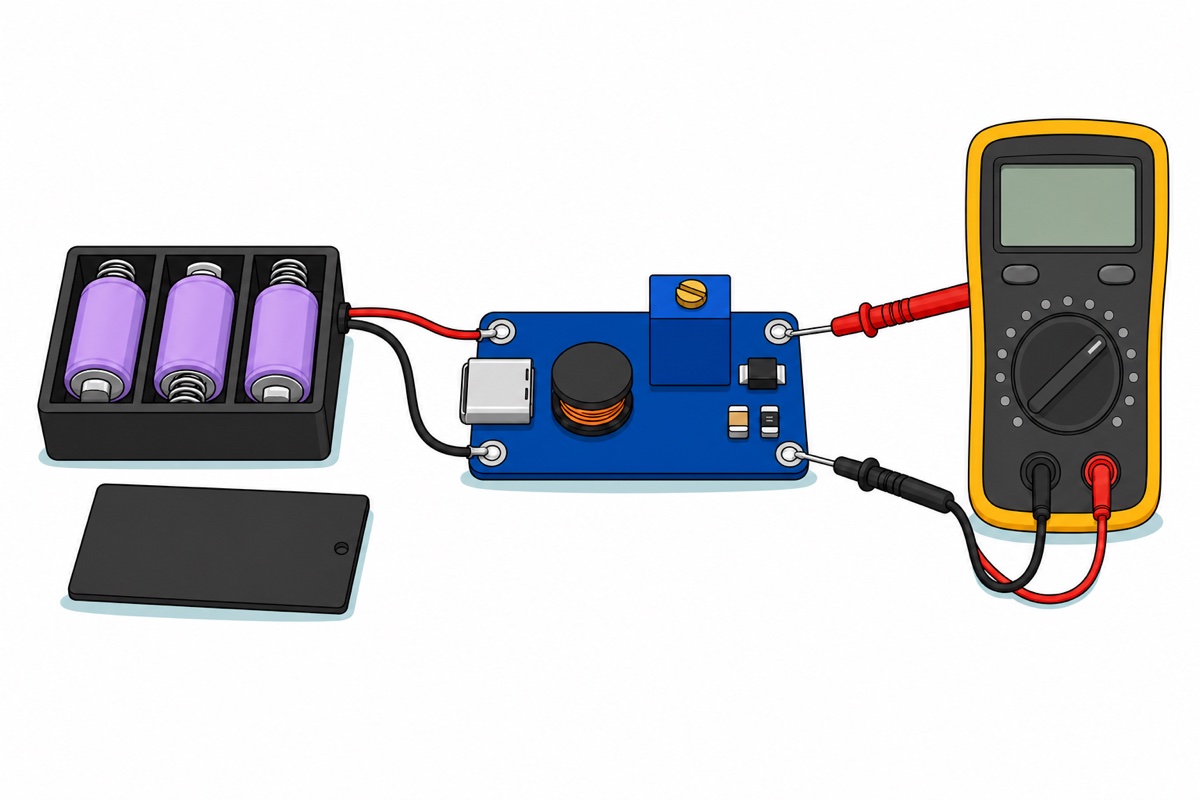
Wire the converter to the right holes, then set the output. The HW-183B’s USB-C socket is an input for a 5 V supply, not a way in for a battery: the holder’s red lead goes to the pad marked VIN+ and the black to VIN−, and every one of those pads is a bare plated hole, so this is a soldering job. Its blue multi-turn trimmer arrives wherever the factory left it, so power the input, put a multimeter across OUT+ and OUT−, turn the brass screw until it reads right, and only then wire in your circuit. And “neither” is a real answer: if every module is happy on 4.8 V, four NiMH cells straight from the 4-slot holder is the most efficient supply there is — every converter takes its cut in heat.
How do I see what my own pack is doing?
The Arduino’s own ADC is the cheapest pack monitor you own, and watching your pack drop settles every argument above. This sketch reads it through a two-resistor divider on A0 and prints volts per cell once a second, measuring against the ATmega328P’s internal 1.1 V reference rather than the 5 V rail — that rail is the thing under suspicion, and measuring against it would hide the sag. Join the pack’s negative lead to the Arduino’s GND and power the Arduino over USB: here the board is a meter, not the project, so it stays on the cable while the pack drives the load you are testing. That internal reference varies a little from chip to chip, so check one reading against a multimeter and edit V_REF to match. It compiles to 3,718 bytes.
// AA pack monitor - prints pack volts and volts per cell once a second.
// Wire a divider: pack + --> 100k --> A0 --> 18k --> pack - , and join
// pack - to the Arduino's GND. Power the Arduino from USB while you measure.
// 18k / (100k + 18k) = 0.1525, so A0 stays under the 1.1 V reference
// until the pack passes 7.2 V - above anything four AA cells can reach.

const int   PIN_PACK = A0;
const int   CELLS    = 4;         // how many cells are in the holder
const float R_TOP    = 100000.0;  // ohms, pack + to A0
const float R_BOTTOM = 18000.0;   // ohms, A0 to ground
const float V_REF    = 1.1;       // volts, the ATmega328P's internal reference

void setup() {
  Serial.begin(9600);
  analogReference(INTERNAL);      // 1.1 V on Uno and Nano
  analogRead(PIN_PACK);           // first reading after the switch is stale
  delay(10);
}

void loop() {
  long sum = 0;
  // The divider is a 15 k source, above the 10 k the ATmega's ADC prefers, so
  // stay on one channel and read it repeatedly - its sample capacitor tops up
  // between reads. The averaging is for noise, not for that.
  for (int i = 0; i < 16; i++) {
    sum += analogRead(PIN_PACK);
    delay(2);
  }

  float counts = sum / 16.0;
  float vAtPin = counts * V_REF / 1023.0;
  float vPack  = vAtPin * (R_TOP + R_BOTTOM) / R_BOTTOM;

  Serial.print(vPack, 2);
  Serial.print(" V pack, ");
  Serial.print(vPack / CELLS, 3);
  Serial.println(" V per cell");
  delay(1000);
}
Why is the pack always flat when the project comes out of the drawer?
A NiMH cell loses charge with nothing connected, because its charged positive electrode is unstable and slowly reduces itself inside the sealed can. Heat speeds that reaction up, and the Panasonic handbook measures exactly that: after four weeks of storage its cells hold roughly 85 % of their charge at 20 °C but only about 58 % at 45 °C. A Malaysian cupboard sits between those curves, nearer the warm one than a bench test assumes.
Low-self-discharge cells — the Eneloop class — use a different separator chemistry to slow that reaction, trading a little capacity to keep most of their charge for a year. You can tell the two apart in the shop, because an LSD cell advertises the fact on its wrapper — pre-charged, ready to use — and charges extra for it. Our 2,000 mAh cell is a standard NiMH type, so treat it as one: charge the pack the night before the demo, not last month. Alkaline has the opposite habit, sitting in a drawer for years, which is why wall clocks and remotes still ship with one. It pays for that shelf life another way: left in a project until it is properly flat, an alkaline vents potassium hydroxide, and that white crust eats the holder’s springs and the copper in the leads. Cells come out of the holder before a project goes into a drawer.
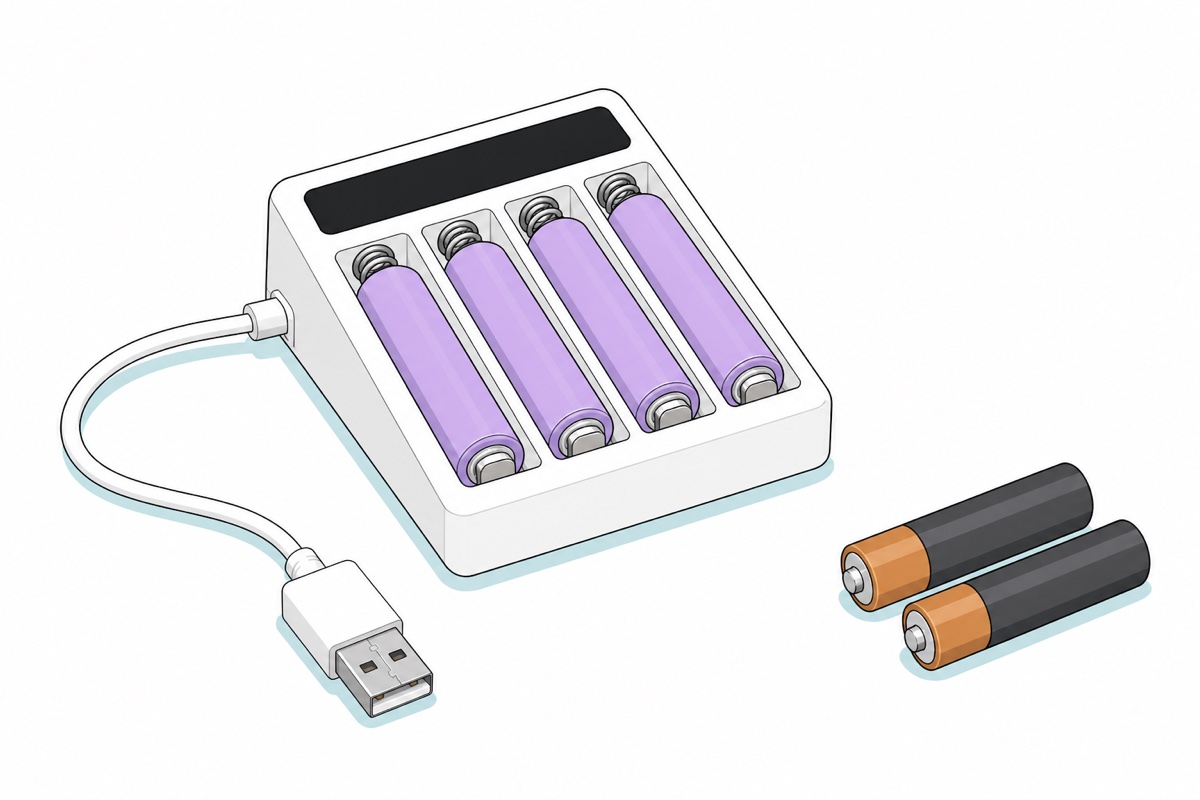
Charge NiMH in a NiMH charger. The 4-slot USB charger takes Ni-MH and Ni-Cd, and a charger for those chemistries has to watch for the small voltage dip and the warmth a nickel cell shows at the moment it fills, because a nickel cell has no fixed full voltage the way a lithium cell does. So a lithium charging board or a bench supply is no substitute: they stop at a voltage, and here there is none to stop at. Take a nickel pack off charge once it is done rather than leaving it sitting there. An alkaline is not built to accept charge current at all: forcing it in makes gas and heat inside a sealed can that can vent or leak. Alkalines never go in the charger.
When should you stop fighting AA cells and move to 18650?
Four AA NiMH cells store 4.8 V × 2 Ah ≈ 9.6 Wh in about 100 g of cells. One 2,200 mAh 18650 stores 3.7 V × 2.2 Ah ≈ 8.1 Wh in one 45 g cell — near enough the same energy at half the weight, at a nominal voltage that is already the native input of most boost modules and every USB charging board. Move up when you want to charge in place over USB instead of unloading four cells into a cradle.
Everything past that is lithium, and this guide stops here on purpose: see charging 18650s safely with a TP4056, Li-ion, LiPo and LiFePO4 compared, and powering ESP32 projects.
Common mistakes we see from real customers
Mixing cells in one holder. A new cell beside a tired one, or NiMH beside alkaline: the weakest empties first and the other three then push current backwards through it, and a reverse-charged cell gasses, heats and leaks into the contacts. Match chemistry and age, and replace as a set.
Buying rechargeables without a charger for them. NiMH cells arrive part-charged, and there is no filling them from a USB port or a lithium board. Budget for the charger with the first set of cells.
Judging a pack with an unloaded multimeter. An alkaline pack reading 5.8 V on the bench can collapse well under 5 V the instant a servo starts, because an open-circuit reading never pushes current through the cells’ resistance. Measure while the circuit runs.
Running the board and the motors from one AA pack. A servo starting up pulls the pack down through its internal resistance, and the microcontroller sitting on the same two wires sees that dip on its own supply and resets — a project that restarts whenever something moves, which reads like a code bug and is not one. Give the motors their own pack and join only the grounds.
Running the holder’s bare leads into a barrel plug. The leads end in bare tinned wire, and fitting a DC plug for the Uno’s jack is the obvious move — and the wrong one, for the dropout reason above. To an Uno the pack goes through a converter to the 5V pin; to a servo it can go straight.
FAQ
Can I use 1.2 V rechargeable AA batteries instead of 1.5 V alkaline?
Usually yes, but check the pack total, not the cell: four NiMH give 4.8 V nominal against 6.0 V for four alkalines. Servos and 5 V logic are happy at 4.8 V; anything wanting 6 V or more, an Arduino’s DC jack included, is not.
How many AA batteries do I need to power an Arduino?
Four NiMH cells into the 5V pin, USB unplugged, is the simplest route: 4.8 V nominal sits inside the board’s 4.5–5.5 V window. Not the DC barrel jack — Arduino’s 6 V minimum is specified at the VIN pin, and the jack sits a rectifier drop above even that, so a four-cell NiMH pack reaches neither.
Why does my project work on alkaline but not on rechargeable AA?
Almost always a per-cell shortfall that only shows up multiplied: 4.8 V instead of 6.0 V from the same holder. Anything sized around a 6 V pack — a barrel-jack input, a 6 V motor, a relay coil — is now under-fed. Wire a 3-slot and a 2-slot holder in series for a five-cell 6 V NiMH pack (7 V straight off the charger, so check the load’s ceiling), or boost three cells to a regulated 5 V — but neither reaches an Arduino barrel jack, which stays out of range on AA cells either way.
Is a 2000 mAh NiMH cell really 2000 mAh?
Yes, at its rated low drain and down to 1.0 V per cell, and it holds a flat 1.2 V while delivering it. Alkaline labels are the ones to distrust under load: Energizer’s E91 chart falls from about 3,050 mAh at 25 mA to about 1,530 mAh at 500 mA.
Why are my rechargeable AA batteries flat after sitting in a drawer?
Standard NiMH self-discharges on the shelf and heat accelerates it — Panasonic measures roughly 85 % remaining after four weeks at 20 °C but only about 58 % at 45 °C. In Malaysian ambient, charge the night before, or buy low-self-discharge cells for anything stored between uses.
Last updated August 2026. Stuck? Chat with us on WhatsApp.
