

Tutorials
Soldering Iron Buying Guide: Why Soldering Won’t Stick
Aug
Buy an adjustable-temperature iron rather than a fixed pencil, and when solder refuses to stick, stop turning the heat up — the fault is almost always oxide. Molten solder bonds only to bare metal. Flux exists to strip the oxide film off copper so the solder can wet it, instead of rolling off the joint as a dull grey ball.
Which soldering iron should you buy first?
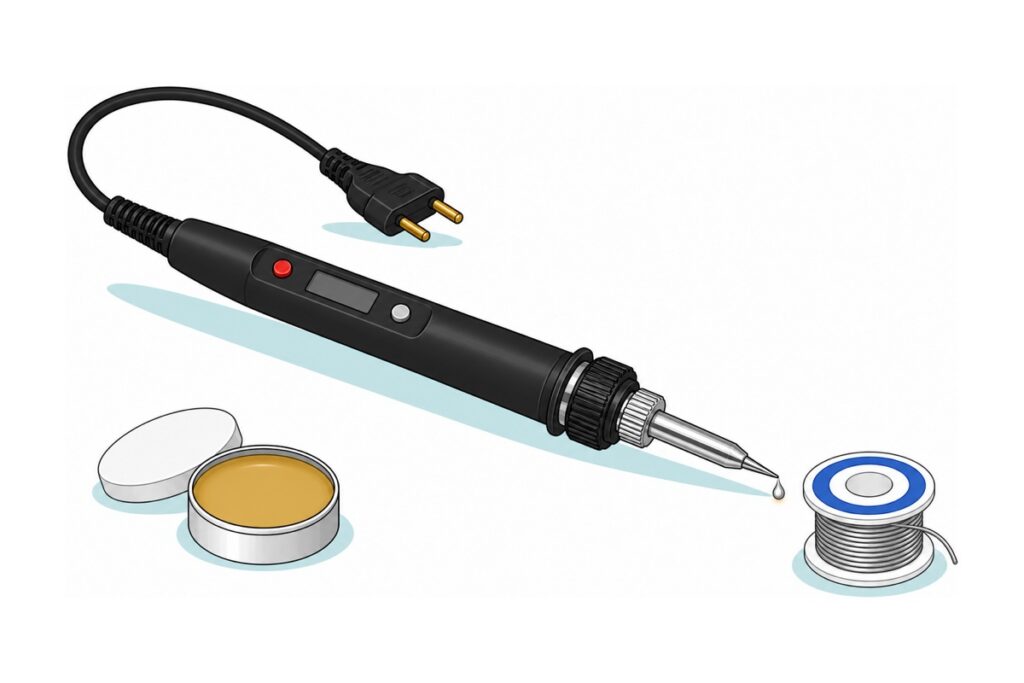
The 80 W adjustable-temperature iron is the one to start on, and not because of its top number: it is that this iron knows what its own tip temperature actually is.
A fixed pencil iron carries no sensor at all. Its element pushes out a constant amount of heat, and the tip settles wherever that input balances the heat leaking away into the air and into the work. Press it onto a fat copper ground plane and the losses jump, the balance point falls, and nothing inside the tool pushes back — the tip can slide below the solder’s own melting point while the handle feels identical in your hand. That sag is the sticky grey blob people blame on bad solder.
The adjustable iron closes that loop. A temperature sensor sits inside the ceramic element beside the tip — which is precisely why the LCD in the handle can display a number at all — and a controller compares it with the set point you dialled on the + and − buttons, driving the heater hard whenever the reading falls. Feedback on its own recovers nothing, though — it decides when to push, and the element decides how hard. An iron whose element barely covers its own idle losses has nothing left the moment a joint drains heat away, which is why a weak iron with a knob still sags. At 80 W most of that output is spare capacity, idle until the tip lands and then spent in a second. You are buying recovery, not peak heat. Its range is 180–480 °C; set 300–350 °C, because leaded flux-core solder is fully liquid by 190 °C and that margin is what survives contact with a cold joint. Lead-free alloys melt roughly 30 °C higher, so move the set point up to match whatever is on your spool.
That also settles the “soldering station” question. A base unit buys a bigger element and a longer working day, not better joints. For through-hole hobby work a temperature-controlled pencil iron is the sensible first station, and it is what we put in a beginner’s hands — the portable one too, since 242 mm of iron and a 1.4 m lead coil into a toolbox where a base station will not.
| Iron type | What sets the tip temperature | Where it falls over | Suits |
|---|---|---|---|
| Fixed pencil, no display | Element output against heat lost — no feedback | Sags on big joints, runs hot at idle, tip oxidises fast | The occasional wire splice |
| Adjustable-temperature pencil (sensor + LCD) | Closed loop against your set point, 180–480 °C | Very heavy copper, hours at a stretch | Hobby electronics — start here |
| Base-unit bench station | Closed loop plus a bigger element and transformer | Cost and bench space | Daily production-rate work |
Parts list — a first soldering bench that actually takes solder
| Item | Price | Qty | |
|---|---|---|---|
 80W Electronics Soldering Iron with LCD Display Ajustable Temperature Microconstroller Electronic ProjectASOIRON 80W Electronics Soldering Iron with LCD Display Ajustable Temperature Microconstroller Electronic ProjectASOIRON | RM39.95 | ||
 50g Soldering Wire Lead with Flux Core 1mm Diameter50SOTIN 50g Soldering Wire Lead with Flux Core 1mm Diameter50SOTIN | RM9.90 | ||
 20g Soldering Paste Rosin Flux Lead-Free Blending Easy SolderSOPASTE 20g Soldering Paste Rosin Flux Lead-Free Blending Easy SolderSOPASTE | RM12.95 | Out of stock | |
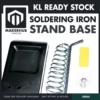 Soldering Iron Stand Metal Spring Holder Support Station Base Heat Resistant Workshop Electronics DIY ToolSOLDSTA Soldering Iron Stand Metal Spring Holder Support Station Base Heat Resistant Workshop Electronics DIY ToolSOLDSTA | RM3.90 | Out of stock | |
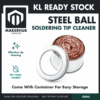 Soldering Iron Tip Cleaner with Container Steel Ball Tip CleaningBRBALLC Soldering Iron Tip Cleaner with Container Steel Ball Tip CleaningBRBALLC | RM5.95 |
Worth adding
| Item | Price | Qty | |
|---|---|---|---|
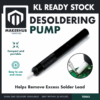 Desoldering Pump Solder Cleaner Sucker Vacuum Soldering RemovalDESOLPU Desoldering Pump Solder Cleaner Sucker Vacuum Soldering RemovalDESOLPU | RM6.95 | ||
 Sodering Clip Stand with Magnifying Glass Soldering Holder Electronics Project Assistance HolderSOLCLIP Sodering Clip Stand with Magnifying Glass Soldering Holder Electronics Project Assistance HolderSOLCLIP | RM12.95 |
For undoing mistakes and holding the work — the pump lifts molten solder off a joint you want to redo, the clamp holds board and wire still while both hands are busy.
Why won’t your solder stick? The five reasons
Solder does not glue. Molten tin alloys with the surface it touches, growing a thin intermetallic layer, and that reaction runs only where liquid solder meets bare metal. Put an oxide film in between and there is nothing to react with, so surface tension pulls the solder into a ball and it rolls off. “It won’t stick” therefore always means one of two things: no bare metal at the interface, or an interface that never got hot enough.
- The tip has gone black. An oxidised tip cannot wet, so it cannot hand heat over either — the commonest cause by a wide margin, and the tip section below deals with it.
- The flux burnt off before the joint was hot. Rosin does nothing cold — it only begins stripping oxide as it nears solder’s own melting point, and it is spent within seconds at 350 °C, so a blob melted onto the tip and carried across arrives as dead solder on an oxidised pad. Feed fresh wire into the joint, where the heat is.
- You are heating the solder, not the joint. Solder melting on the tip tells you nothing about the pad. Touch the iron to pad and leg together for a second or two first, laying the side of the tip across both rather than dabbing with the point — contact area is what moves heat, and the fine conical point fitted as standard puts very little of itself on a fat ground plane. Solder meeting cool copper freezes on contact into a lump sitting on top.
- The pad or the leg is oxidised. This is what the tin of rosin flux paste is for — a dab clears the film that the wire’s own small flux charge cannot. A rub with a pencil eraser first helps on badly tarnished copper.
- The metal is not solderable with rosin at all. Aluminium regrows an oxide skin within seconds of being scratched clean, and it takes a dedicated aluminium flux to remove the tenacious oxides that prevent the solder from wetting — rosin cannot, so solder sits on the oxide and never touches metal. Stainless steel behaves the same, and no temperature fixes it.
None of the five hurts the board, and none is worth forcing. A joint that balled up or froze into a lump is undone the way it should have been made: fresh flux-core wire in to re-wet the lump, let it flow, lift the solder away with a desoldering pump, then start again on a clean pad. What does real damage is grinding at a cold joint with a dry tip until the copper pad peels off the board.
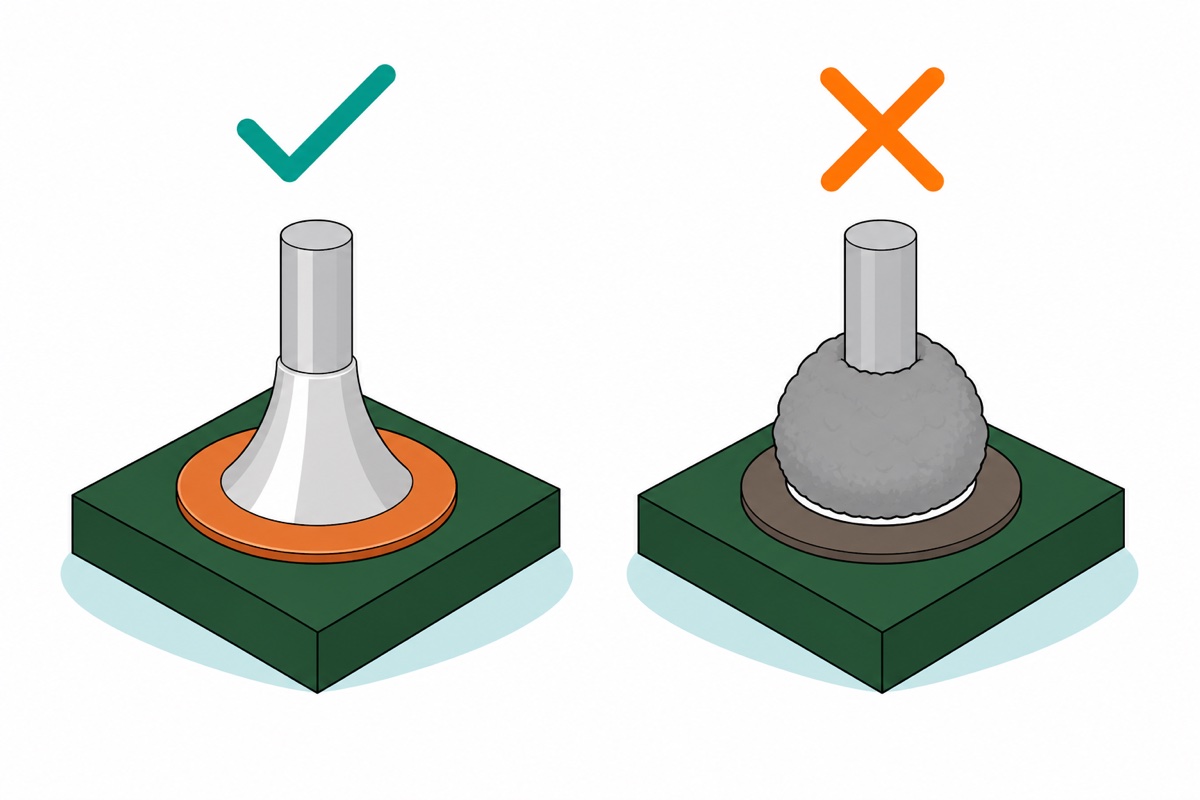
Why is flux used, and is “soldering paste” the same thing?
Flux is a mild acid that goes inert as it cools. Rosin, tapped from pine resin, is largely a mixture of rosin acids; heated, its main acid combines directly with the oxide on the copper surface and carries it off as a dissolved copper salt, exposing bare copper. It then does two more jobs in the same second: the molten rosin blankets that metal so air cannot re-oxidise it, and it lowers the surface tension at the boundary so the solder spreads into a fillet instead of beading.
Our 50 g flux-core solder wire carries its own supply — hollow wire with rosin down the core, labelled as a 2.0% charge. That figure is small because the delivery is perfect: the flux lands exactly where the solder does, exactly when it melts. On clean copper it is all you need, in the 0.8–1.0 mm general-purpose diameter.
The tin sold as “soldering paste” is a different animal. Ours is a rosin flux paste: a translucent olive-amber wax with no solder metal in it whatsoever. It joins nothing by itself; it prepares surfaces the wire’s 2% cannot rescue. What factories call “solder paste” is powdered solder suspended in flux for reflow ovens — not this.
Paste also leaves far more behind than the wire’s 2 % core, so wipe the cooled joint with isopropyl alcohol. The sticky ring collects dust and holds moisture, and across the pins of a high-impedance sensor that film can quietly leak current.
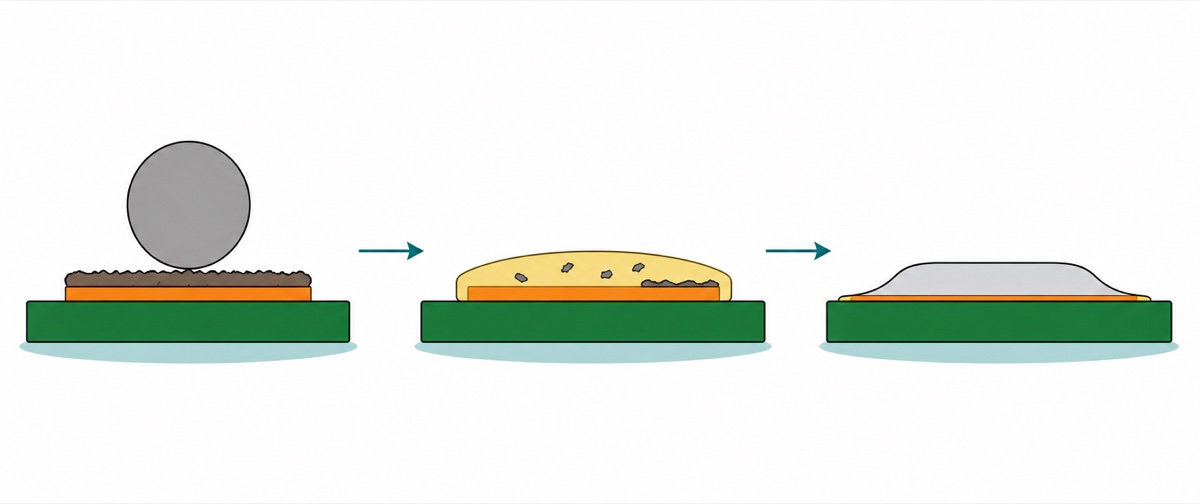
Flux going to work on a stubborn joint makes the difference obvious:
Why does the tip stop taking solder?
A soldering iron tip is a copper core wearing an iron jacket. Copper moves heat superbly, but expose that core and solder will erode it rather quickly, hollowing the tip out, so the working face is iron-plated. That plating is what your solder actually wets — and iron oxidises whenever it is held hot and dry. Once the face turns black, oxide repels solder.
The consequence is worse than cosmetic. A dry tip meets a component leg at a few high points with air, an excellent insulator, filling everything between. A tinned tip carries a meniscus of molten solder that floods that space and multiplies the real contact area, so heat crosses in a second instead of never. “Tin the tip” is a heat-transfer instruction, not a tidiness habit.
So keep it wet. Wipe the tip through the coiled copper-toned wire ball cleaner and re-tin it every few joints. The ball is used dry, and that is the point: a soaking sponge chills the face by tens of degrees at every wipe, and the repeated thermal shock cracks plating. Work at 300–350 °C rather than 450 °C, since oxidation accelerates sharply with temperature, and start the habit on the very first heat-up: put solder on a brand-new tip as soon as it comes up to temperature, leave a bead on it when you switch off, and never let it stand hot and dry.
An already-blackened tip is usually recoverable while hot: wipe, press into the flux paste, feed fresh solder on, repeat until silver returns. Once the plating has worn through to raw copper the tip is finished, and this iron takes standard 900M-series replacements.
Seat any tip fully, and re-seat one that has worked loose. The sensor sits in the element, not in the tip, so the display reports the element — the tip matches that number only when it is pushed right home over the heater with the collar nut tight. A tip standing a few millimetres proud shows a confident 350 °C on screen and melts nothing, and that is what a good share of “my iron is not heating” turns out to be.
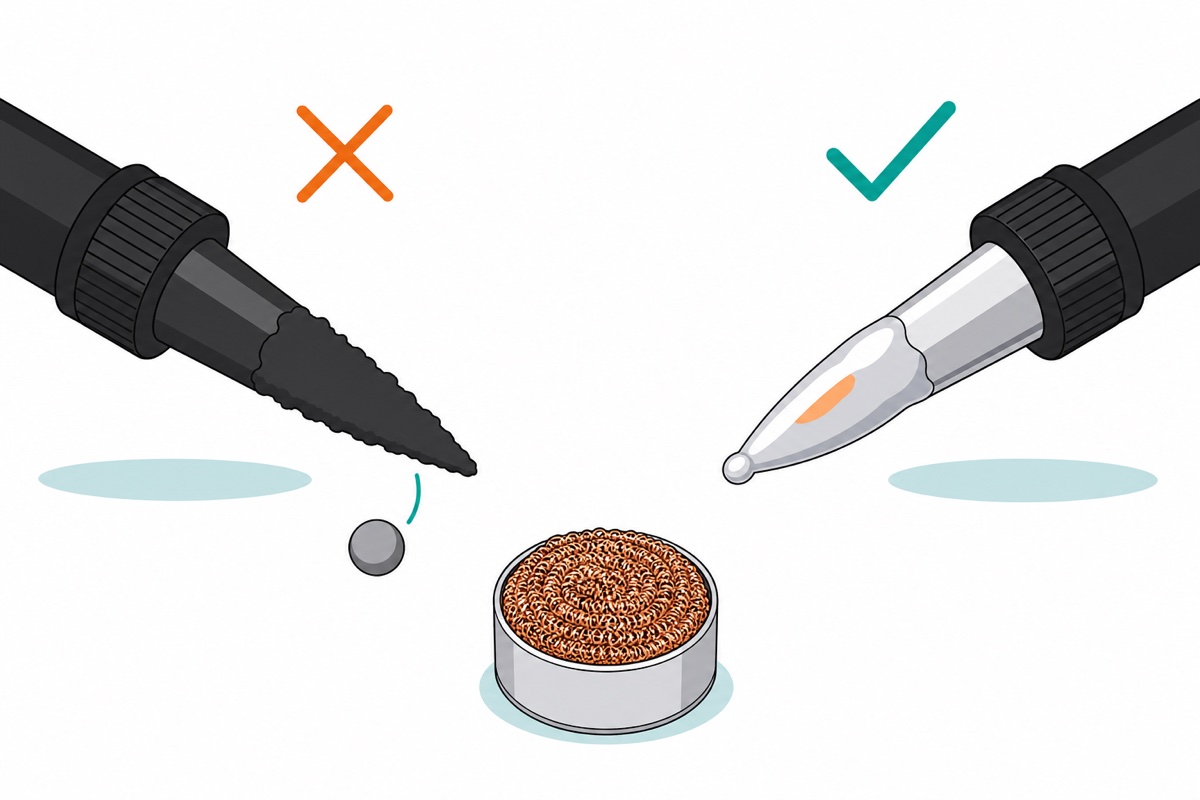
The tinning routine itself, at bench speed:
How do you stay safe with a mains iron?
A mains soldering iron runs on Malaysia’s 240 V supply and its tip reaches 480 °C, so an iron laid straight on the bench is how cables and fingers get burnt. Assemble the stand before first use — black base tray, chrome coil spring, two hex nuts and a yellow sponge, flat-packed and bolted together in a minute. The sponge arrives as a hard compressed wafer: soak it, wring it out until it is only damp, and seat it in the well — dripping wet is what steals tens of degrees a wipe, which is why the wire ball does the routine cleaning. Where space is tight, the small bakelite-base stand with a metal rest does the same job.
The iron ships with a two-round-pin europlug, the usual fitting on small continental tools. Electrically it is comfortable — 80 W at 240 V is about 0.33 A — but it is not a Malaysian BS 1363 three-pin, and a BS 1363 socket keeps its live and neutral holes shuttered until the longer earth pin pushes them aside, so two round pins will not simply go in. That is the socket working as designed, not a fault in the iron: a two-pin mains fitting is the double-insulated pattern normal for small continental tools. Use a proper moulded europlug-to-three-pin adapter that grips both round pins along their whole length — a loose contact arcs, and arcing is what melts a socket face. Never force the pins in.
The smoke is burning flux, not lead vapour — lead boils near 1750 °C, so nothing happening at 350 °C is putting it into the air. Rosin fumes do irritate airways, though: window open, fan on, face out of the plume. If your spool is leaded, the exposure that matters ends up on your fingers, so wash hands before eating. And never solder anything still plugged into mains or wired to a charged battery.
Common mistakes we see from real customers
Turning the temperature up when a joint won’t take. Hotter tips oxidise faster and flux burns off before it can clean anything. Drop back to 320 °C, re-tin the tip, try again.
Buying an iron and nothing else. “Do you sell solder iron?” is one of the questions we are asked most, and the honest answer is that the iron on its own is half a bench. No stand, so it gets put down somewhere; no cleaner, so the tip blackens on day one; no flux paste, so the first dull pad wins.
Trying to tin an aluminium or stainless bracket. No amount of heat, solder or rosin will make that joint. Use a fastener, or crimp.
FAQ
Why won’t my solder stick to the pad or the wire?
Something oxidised is in the way. Check the tip first — black means it neither wets nor transfers heat. Then feed fresh flux-core wire into the joint rather than carrying a blob, and dab flux paste on a dull pad.
Why is soldering flux used, and is it the same as soldering paste?
Flux strips the oxide film off the metal, blankets the clean surface against air, and lowers surface tension so solder spreads into a fillet. Our tin of “soldering paste” is rosin flux paste — an olive-amber wax with no solder metal in it — so it prepares surfaces but joins nothing alone.
My soldering iron is not heating up. What should I check?
Check the set point has not been left at its minimum, and allow 60–90 seconds from cold, testing on a scrap of solder rather than by touch. If it heats but joints still fail, the element is fine and the tip is oxidised. A display that reads its set point while the tip melts nothing usually means the tip is not pushed fully home, since the sensor sits in the element rather than in the tip. A display that never lights at all is usually a cord fault — a continuity check on the unplugged lead confirms it.
How do I solder without a soldering iron?
For electronics, don’t. A flame or a heated screwdriver cannot be held near a controlled temperature, so they either fail to melt solder or cook the board. If soldering is truly out, design around it: screw terminals, crimped ferrules, modules with headers pre-fitted.
How do I solder a lithium battery?
Not onto the cell body — that is the hard no here. Cell makers are explicit: an 18650 datasheet caps the cell’s own surface at 70 °C and tells you plainly, do not solder on the surface of the Cell directly. An iron holds 300 °C-plus against a terminal for seconds, and that heat degrades the separator and the seal, so a damaged cell can vent or catch fire days later. Use a holder, or cells with tabs already spot-welded — our TP4056 charging guide covers wiring an 18650 in safely.
New to the iron itself? Our guide to soldering header pins covers the technique joint by joint.
Last updated August 2026. Stuck? Chat with us on WhatsApp.

Pingback: 18650 Battery Charger for a 3S Pack: Series vs Parallel
Pingback: Stepper vs Servo vs DC Motor: Which for Your Arduino?
Pingback: Electrical Insulation Tape vs Heat Shrink Tubing
Pingback: Donut Board: How to Connect Pads and Solder Your Circuit