

Tutorials
Electrical Insulation Tape vs Heat Shrink: What Survives Malaysian Heat
Aug
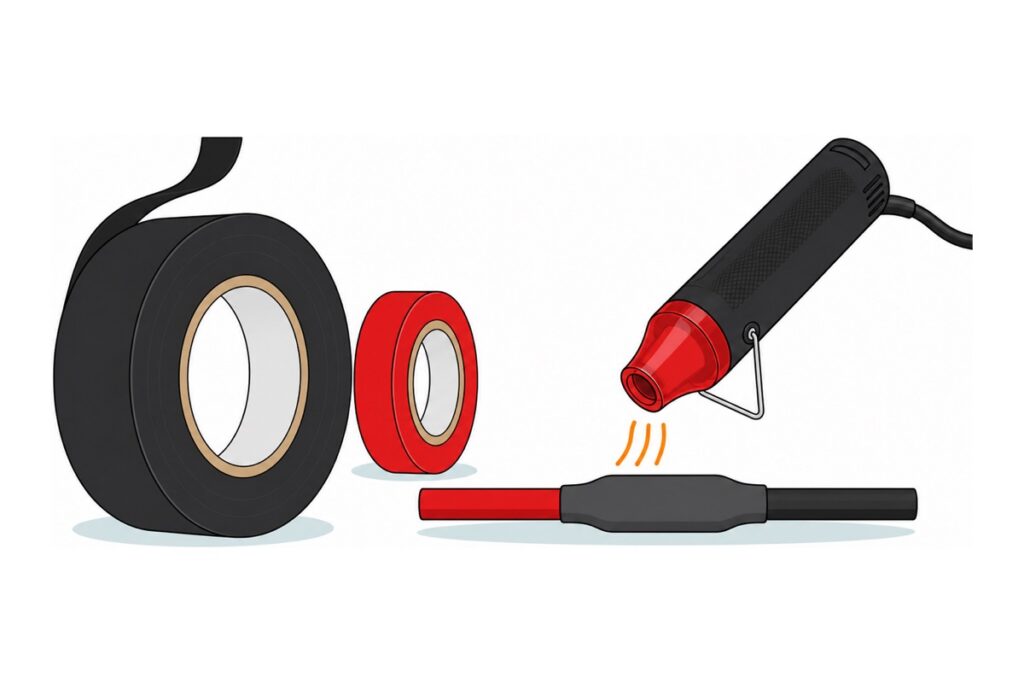
Heat shrink tubing is the right cover for any joint you will not open again, PVC electrical insulation tape is for colour-coding, bundling and joints you will revisit, and a solder sleeve makes the joint and seals it in one step. Tape is the one that fails in Malaysian heat, for a specific reason: its adhesive goes soft long before the PVC film does.
Everything below is low-voltage DC project wiring — battery leads, motor wires, sensor extensions, 12 V LED strip. Mains is a different job: 230 V fixed wiring in Malaysia is work for a wireman registered with the Energy Commission, and no tape comparison changes that.
Which one should you actually use?
PVC insulation tape, heat shrink tubing and solder sleeves fail in completely different ways, so the choice follows where the joint has to live.
| Method | How it holds | Best for | Where it lets go |
|---|---|---|---|
| PVC insulation tape | A pressure-sensitive adhesive gripping the wire and itself | Colour-coding, bundling looms, awkward shapes, anything you will open again | Heat, oil, and its own stored winding tension |
| Heat shrink tubing (polyolefin) | The plastic contracts and clamps mechanically | Permanent joints, strain relief at connectors, hot or vibrating places — adhesive-lined for wet ones | You forgot to slide it on first, or the size arithmetic was wrong |
| Solder sleeve | An internal solder ring and adhesive bands that melt while the tubing shrinks | Waterproof joints where you cannot get an iron in | Under-powered heat source, or wire too thick for the ring |
Parts list — the tape, and the tool that shrinks tubing properly
 Electrical Insulation Tape 18mm x 10m PVC Color Coded Marking Red White Blue Yellow Green Black - ELECTRICAL TAPE (BLACK)
 300W 230V MINI HOT AIR HEAT GUN UK PLUG FOR DIY CRAFT SHRINK TUBING EMBOSSING
Parts list
 Electrical Insulation Tape 18mm x 10m PVC Color Coded Marking Red White Blue Yellow Green Black - ELECTRICAL TAPE (RED)
 80W Electronics Soldering Iron with LCD Display Ajustable Temperature Microconstroller Electronic Project
 50g Soldering Wire Lead with Flux Core 1mm Diameter
 XL830L Digital Multimeter with backlight Portable Multimeter Electronics Project
Red tape for colour-coding the positive lead. The iron and solder are for making the joint before you cover it — skip them if you already own a set. The multimeter is for proving the joint conducts while you can still get at it.
Insulation goes over a joint that is already sound. Lap the strands and solder them with an adjustable iron and flux-cored solder — our guides to irons and flux and soldering technique cover that — then prove continuity with a multimeter first, using the continuity setting. An iron tip runs in the hundreds of degrees and burns on contact, so it belongs in its stand between joints.
Two details in that joint decide whether the cover survives. Lay the bared ends alongside each other and solder them lapped rather than butted end to end, then fold the soldered length back flat against one of the wires — that halves the length you have to cover and tucks the cut strand ends away. One strand left standing proud will work its way through a tape wrap or spear the wall of a shrunk sleeve, and it does it slowly, so the short turns up weeks after the job looked finished. Run a thumb along the joint in both directions before you cover it: it should catch on nothing.
Why does PVC insulation tape lift and unwind in Malaysian heat?
PVC electrical insulation tape is two materials with two jobs. The film is a thin plasticised vinyl ribbon and does the insulating — vinyl tapes to UL 510 are rated 600 V, premium grades for continuous service to 105 °C. The adhesive is a soft rubber-resin layer that flows slowly under pressure to wet whatever it touches. The adhesive, not the film, is the temperature-limited part.
It has no melting point; it simply gets softer, and its resistance to sliding falls steadily as it warms. Vinyl meanwhile is elastic and has memory, so wrapping it under tension leaves every turn a small spring trying to shorten. Cold adhesive holds those springs and warm adhesive does not, and the free end is where the two forces meet — so the tail creeps back, lifts, and stands off waving loose. Electricians call it flagging.
Malaysia’s 27–35 °C ambient is not itself the problem; enclosed spaces are. In one instrumented study of a saloon car parked in the sun with the windows shut, a 32.0 °C mean ambient produced 63.5 °C mean cabin air at the dashboard with a 72.4 °C peak; cracking the front windows 4 cm only brought that mean to 47.6 °C, and surfaces run hotter still. An unvented project box in the sun sits in the same band, and the joint adds its own heat. Tape indoors in free air lasts years; the same wrap in a hot box walks loose.
How do you wrap tape so that it stays wrapped?
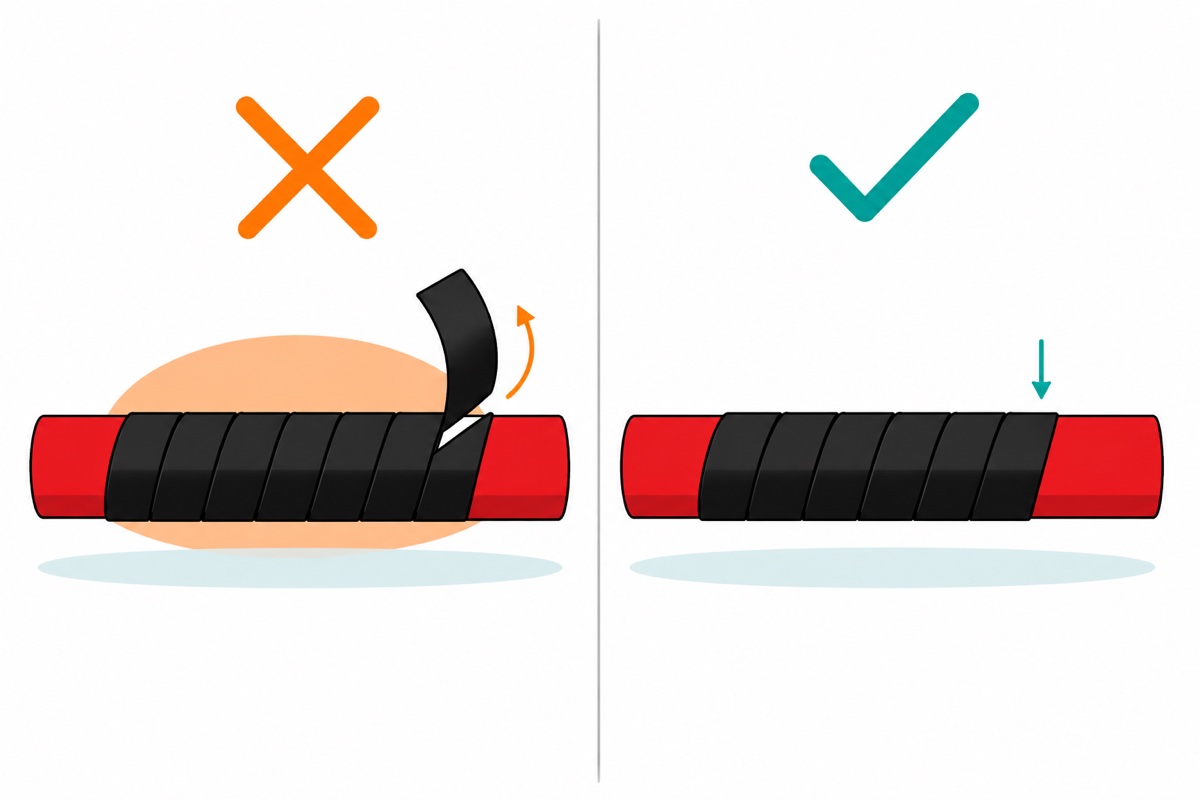
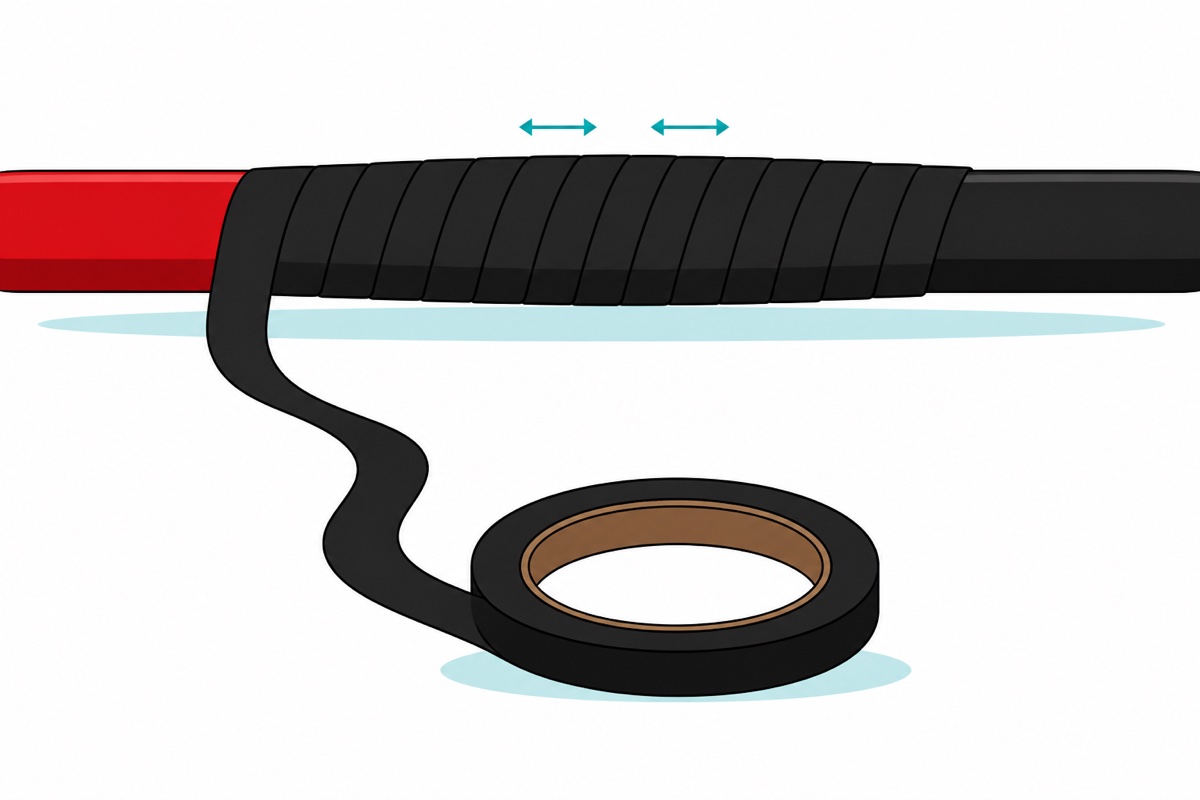
PVC insulation tape has to go on half-lapped, and half-lapping is technique, not decoration. Each turn of the 18 mm black roll covers half the previous one, so every point along the joint ends up under two thicknesses of vinyl from a single pass — and two half-lapped layers give four. That is what the 600 V rating assumes.
Start and finish on the wire’s own jacket, two tape widths beyond each end of the joint, so the seal anchors to smooth insulation rather than to a lump. Through the body of the wrap, pull firmly enough that the 18 mm width necks in to roughly 11 mm — that stretch is what makes vinyl conform into the step at the joint instead of bridging over it. Then stop stretching for the last turn. Lay it on slack and press it with your thumb; pressure-sensitive adhesive needs pressure and time to wet a surface — and a clean dry one. Wipe oil, dust and flux residue off the jacket first: the adhesive cannot wet a film of grease, and a wrap that fails for that reason fails from underneath, where nothing shows until it lifts.
Colour does the other half of the job. The roll comes in six colours, and red on the positive lead of a DC pair is cheap insurance against reversing a battery later. Locally it gets called isolation tape as often as electrical tape — same product. Treat the colour as a note to yourself, not a marking anyone else should trust.
The wrist motion is worth watching:
How do you pick the right heat shrink size?
Heat shrink tubing is sold by two numbers and you need both: the supplied inside diameter as it comes off the reel, and the shrink ratio — a 2:1 polyolefin tube recovers to half its supplied diameter, a 3:1 tube to a third. We carry the tape and the gun; for the tubing itself, buy one assorted box of mixed diameters from any hardware shop rather than single sizes — the diameter you need changes with almost every joint, and a mixed box covers the lot.
The size rule has two ends, and one tube must satisfy both:
- Supplied ID must clear the fattest part. It has to slide freely over the finished joint — allow at least 25% over the joint’s widest measurement, because a tube you force is a tube that tears or bunches.
- Recovered ID must be smaller than the thinnest part it grips. A tube that only reaches the wire’s own diameter is resting on it, not clamped to it, and water and vibration get in at the ends.
Work it through. Two 20 AWG wires measure about 2 mm across the insulation; lap-soldered and folded back, the joint is roughly 4 mm. Add the clearance and the supplied ID must be at least 5 mm. Test the ratios at that size: a 5 mm 2:1 tube recovers to 2.5 mm, wider than the 2 mm wire, so it finishes loose at both ends; a 5 mm 3:1 tube recovers to about 1.7 mm and grips. That is the whole argument for 3:1 — over a splice twice the wire’s diameter, 2:1 cannot clear the joint and still close on the wire.
Length gets no help from the ratio, so it needs its own rule: cut the tube to lap at least 10 mm of plain insulation past each end of the joint. Polyolefin draws in along its length as well as around it, so a piece cut to the exact length of the joint finishes shorter than the joint.
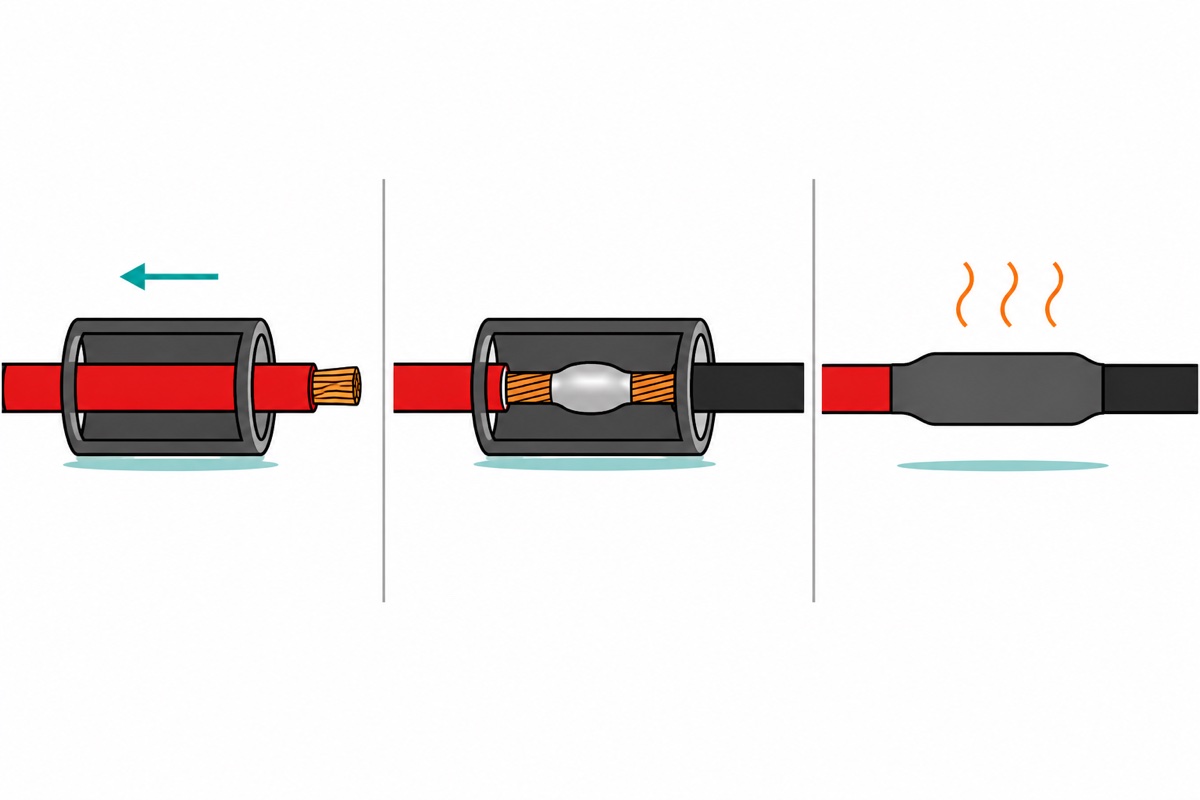
Cut the piece and slide it onto a wire before you make the joint, pushed back far enough that neither the iron nor the hot air reaches it. A soldered joint cannot be threaded through a closed tube afterwards, and this is the commonest reason a good splice ends up taped instead of sleeved.
Watching the two-diameter check done on real tubing makes the arithmetic obvious:
How do you shrink the tubing properly, and where do solder sleeves fit?
The 300 W mini hot air gun suits this, and its numbers say why. Polyolefin starts recovering around 70–95 °C and is not fully down until about 120–125 °C, and once shrunk it is rated for continuous service to 125 °C. The gun tops out near 200 °C — margin enough above the recovery point to shrink in seconds, well below what would scorch the tubing while the nozzle keeps moving. Its UK 3-pin fused plug fits a Malaysian socket directly.
Play the heat across the sleeve and rotate the wire, working outward from the middle so trapped air escapes both ends instead of sealing into a bubble. Disconnect the battery before you bring a 200 °C gun near its leads: a cell that gets heated, or shorted by a half-made joint while you work, is the one thing in this job that can start a fire. A flame will do in an emergency, but it soots, scorches one side before the other has moved, and melts nearby PVC insulation. The nozzle stays hot after switch-off — that is what the fold-out wire stand is for.
A solder sleeve is adhesive-lined tubing with a solder ring moulded inside. Slide it over two overlapped bared wires and heat it: the ring melts into the strands while the adhesive bands seal the ends — joint and waterproofing in one action. That ring is usually a tin-bismuth alloy melting near 138 °C, and makers specify hot air in the 300–400 °C band to make it flow cleanly in seconds. That is above what a 200 °C mini gun delivers, so sleeves are a full-size heat gun’s job; below that airflow the ring takes far longer while the tubing sits cooking around it.
If a sealed joint is what you are after — outdoors, on a bike, anywhere it will meet rain — solder it with the iron and cover it with adhesive-lined (dual-wall) tubing rather than hunting for a bigger gun. Plain polyolefin only grips: water still creeps in at the ends and wicks along the strands underneath, which is how a correctly sized sleeve can still be hiding a green corroded joint. Dual-wall carries an inner hot-melt glue layer that softens at the same temperature that shrinks the tube, so it flows into both ends and sets as a gasket, comfortably inside what the mini gun delivers. You can see it work: a small bead of glue should squeeze out at each end, and if none appears you have not put enough heat in.
Common mistakes we see
Wrapping tape as an open spiral. A helix with gaps between turns leaves parts of the joint under one thickness of vinyl, or none.
Pulling the last turn tight to make it neat. That is the one turn that must go on slack: a stretched tail is the highest-stress point of the wrap on the least-supported adhesive.
Covering a joint that was never tested. A cold solder joint conducts well enough to look fine and fails later under vibration. Two seconds with a continuity beeper beats unwrapping it all.
Splicing every conductor at the same point. Two joints side by side make a lump nothing slides over, and if either cover lifts the bare metal is touching its neighbour. Stagger the joints 20–30 mm apart along the cable, cover each one on its own, then tape or sleeve the pair together if you want a tidy finish.
Using tape to hold a mechanical load. Tape insulates; it does not take strain. If the wires get tugged, strain relief has to be a cable tie, a gland or a clamp.
FAQ
Can I use PVC electrical insulation tape instead of heat shrink?
Yes, for indoor low-voltage joints in free air that you may want to open again. Half-lapped in two layers with a slack final turn, tape holds for years at room temperature. Inside a car or an enclosure the adhesive softens and the wrap lifts, so use heat shrink there.
Why does my electrical tape keep unwinding?
Almost always the last turn went on stretched. Vinyl has memory and tries to return to its original length, so a tensioned tail peels itself off as soon as the adhesive warms. Lay the final turn on with no stretch.
What size heat shrink tubing do I need?
Measure the widest part of the finished joint, pick a supplied inside diameter at least 25% larger, then check the ratio pulls it below the wire’s own diameter. Over a splice twice the wire’s thickness that means 3:1, not 2:1.
Is red insulation tape different from black?
Only in pigment and in what you use it for. Both are 18 mm plasticised PVC film on a pressure-sensitive adhesive, and both insulate a low-voltage joint the same way. Red marks the positive lead of a DC pair or identifies one cable in a bundle; black is the default.
Can I shrink tubing with a hair dryer or a lighter?
A hair dryer rarely reaches the 120–125 °C needed for full recovery, so the sleeve half-shrinks and stays loose. A lighter gets there sooty and unevenly, scorching one side and risking the wire’s insulation. A 200 °C hot air gun is even.
Last updated August 2026. Stuck? Chat with us on WhatsApp.
