

Tutorials
Crocodile clip test leads: when to use them instead of dupont jumpers
Aug
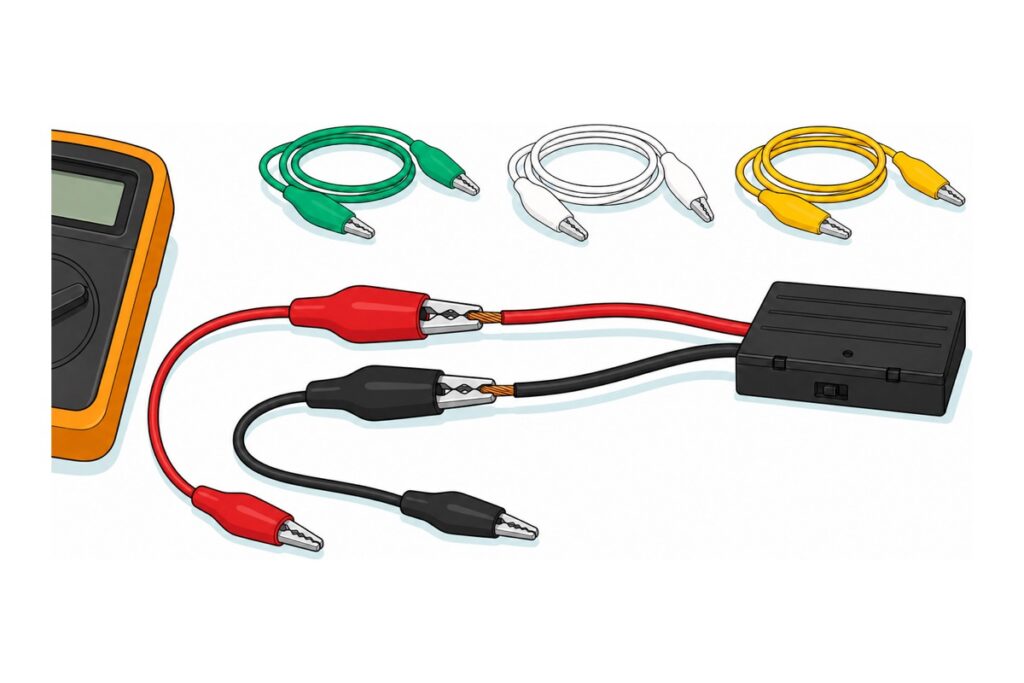
Reach for a crocodile clip lead whenever the thing you need to connect to has no socket to plug into — a battery holder’s bare fly leads, a sensor’s stripped wire ends, a component leg, a lug, a multimeter probe shaft. A dupont jumper only mates with a 2.54 mm pin or hole. A spring jaw grips whatever bare metal fits between its teeth, and keeps gripping after you let go.
A crocodile clip is a sprung metal jaw with serrated teeth, sheathed in a moulded insulating boot and crimped to a flexible wire; a crocodile clip lead carries one at each end. Crocodile clip and alligator clip are one tool under two names — “crocodile” in Malaysia and Britain, “alligator” in America — sold as crocodile clip wires, alligator clips or plain crocodile wire. What decides between one and a dupont jumper is the shape of the far end.
When does a crocodile clip beat a dupont jumper?
A dupont jumper is a connector, not a clamp. Its male end is a 0.64 mm square pin and its female end a socket machined for that pin, both on the 2.54 mm grid headers and breadboards are built to — our jumper wire guide covers that choice. That grid is the whole of its reach, and half of what sits on a bench is not on it: the stripped fly leads of a battery holder, the tinned ends of a waterproof sensor, a resistor leg, a meter probe’s round shaft.
A crocodile clip lead covers that other half with three pieces of physics. A torsion spring behind the pivot supplies the clamping force, so the joint holds itself with nothing from you — that is the hands-free part. The triangular teeth concentrate that force onto a few points instead of spreading it over a flat face, so they bite through the thin oxide and tarnish film that otherwise sits between two touching metals and makes a resistive, drifting joint. And because the jaws pivot open, one clip fits a range of shapes, from a stripped wire to a small tab or a probe shaft.
Each lead is about 35 cm of flexible 22AWG wire with a clip at both ends, and a set gives five colours, two leads each: red, black, green, white, yellow — so two reds and two blacks, one meter pair plus one power pair. These are the small test size of clip — a jaw opens far enough for a stripped wire end, a component leg or a meter probe shaft, and no further. Bench work, not car battery posts.
| What you need to connect to | Use | Why |
|---|---|---|
| Header pin on a module or board | Female dupont end | The socket is built for that pin; a jaw would touch its neighbours |
| Breadboard tie point | Male dupont pin | The hole takes a 0.3–0.8 mm lead; a jaw physically cannot enter it |
| Battery-holder fly lead, bare stripped end | Crocodile clip | There is nothing to plug into — no pin, no socket |
| Sensor’s tinned wire ends | Crocodile clip | Same, and it comes off clean when the trial is over |
| Resistor leg, LED leg, motor tab | Crocodile clip | Holds the part steady while you read the meter |
| Multimeter probe shaft | Crocodile clip over the probe | Turns a hand-held probe into a hands-free connection |
Parts list — clip leads, a meter, and something to clip them onto
 Crocodile Clip Cables 46cm Alligator Clip Cable Multi Color
 XL830L Digital Multimeter with backlight Portable Multimeter Electronics Project
 40pcs Dupont Wire 10cm 20cm 30cm for Breadboard DIY Experiment Jumper Wire Breadboard wire - DUPONT WIRE M-M 20CM
 MB102 Breadboard 170 400 830 Holes Breadboard Donut Board Arduino Prototype Multi Color - BREADBOARD (400 HOLES)
 AA Battery Holder with Cover On/Off Switch 2/3/4 Slots Battery AA Holder Red/Black Wire - AA BATTERY CASE (4S)
Parts list
| Item | Price | Qty | |
|---|---|---|---|
 Temperature Sensor DS18B20 Temperature Measurement Probe WaterProof 18B20DS18B20 Temperature Sensor DS18B20 Temperature Measurement Probe WaterProof 18B20DS18B20 | RM4.95 |
The clip-a-sensor example further down. Its three wires end in bare tinned tips with nothing to plug into — exactly the case a crocodile clip exists for.
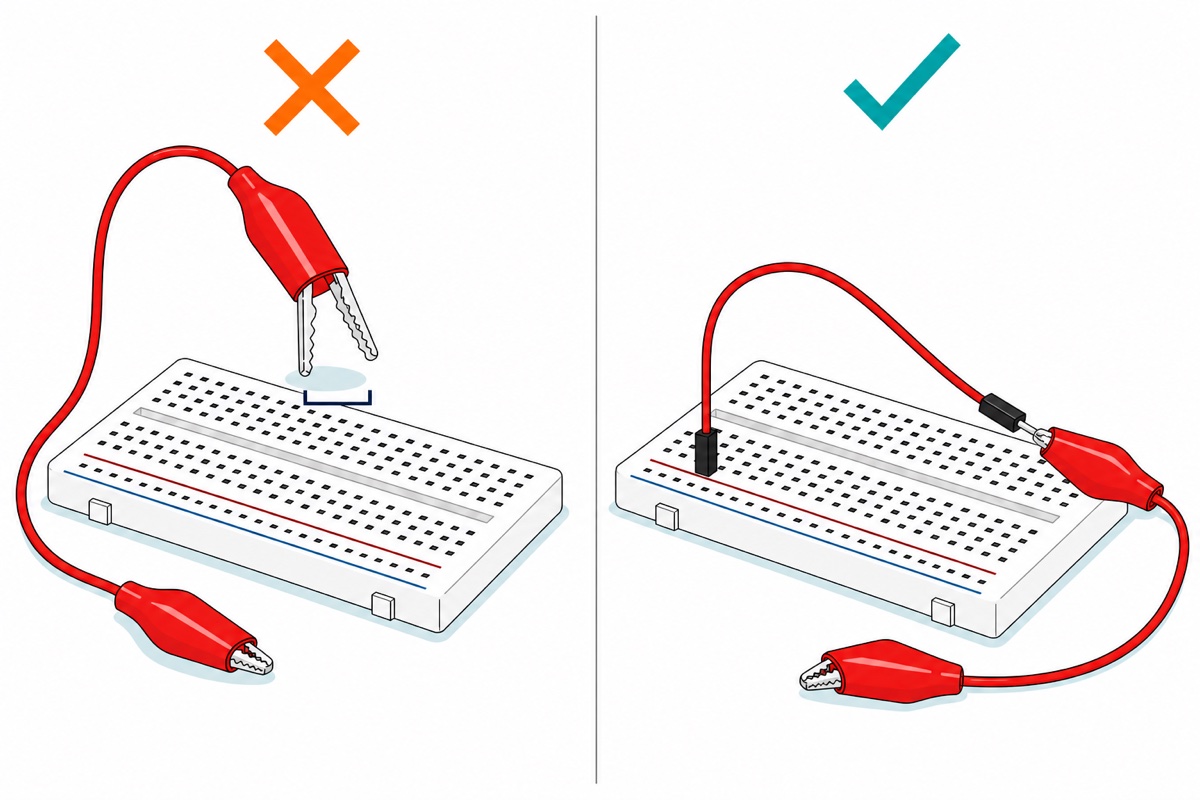
Why can’t a crocodile clip go straight into a breadboard?
A 400-point breadboard puts its tie points on a 2.54 mm grid, each hole a slot in a spring clip sized for a lead of roughly 0.3 mm to 0.8 mm. A crocodile jaw is several millimetres across — wider than the hole spacing itself. It cannot enter a tie point, and laid flat it lands across three or four columns and shorts rows meant to stay separate.
So the hand-off is always the same: push one end of a male-to-male dupont jumper into the board, and clamp the jaw onto the exposed pin at the other end — across the pin rather than onto its point, so both rows of teeth have metal to bite. Grip it close to the black housing where the pin is fully supported, and let the lead rest on the bench rather than dangle. A 35 cm lead hanging off a 0.64 mm pin is a lever: it bends the pin, or walks the jumper’s far end out of its tie point while you are watching the display.
The other limit is current, and the wire tells you what it is. 22AWG copper is 0.326 mm² and runs about 53 mΩ per metre, so a 35 cm lead is roughly 19 mΩ and a there-and-back pair about 37 mΩ — a 37 mV error at 1 A. The copper is not even the weak point. Two metals pressed together only really touch at a scatter of microscopic high spots, so the resistance of a clipped joint is set by how hard the spring squeezes and how much of the oxide film the teeth broke through — not by how good a conductor either metal is. That force comes from one small torsion spring: it falls when a jaw grips a curved probe shaft instead of a flat tab, and it fades as the spring is worked, which is why the same clip can be worth a few milliohms one time and ten times that the next. The crimp inside the boot is the other unknown. Heat therefore shows up at the jaw long before the wire feels anything, so motor stall current and battery charging current belong on soldered joints and screw terminals.
Why is a clip lead the safer way to take a live reading?
The XL830L multimeter ships with a red and a black pointed probe, and a pointed probe only makes contact while you push it. Two of them means two hands holding two sprung tips down while your eyes are on the display. At 2.54 mm pitch a one-millimetre wander puts a tip on the neighbouring pad and shorts two nodes through the probe — at the exact moment you look away to read the number.
Crocodile clips split that into two moments, neither risky. Power down first — the AA holder has an on/off switch for this. Clip the red jaw to the positive point and the black to the negative, set the dial, then switch on and read with both hands off the bench. Power down again before you unclip.
Check the jacks every single time, because self-holding leads change what a wrong jack costs. For voltage the black lead goes in COM and the red in VΩmA — the jack the XL830L marks 600 V and 200 mA maximum. The 10ADC jack beside it is a different animal: inside the meter it reaches COM through a current shunt of a small fraction of an ohm, so a meter left in that jack is close to a plain piece of wire strung between your two clips. Clip that across a battery pack and you have short-circuited the pack — and the meter prints the consequence on its own panel next to that jack, 10A MAX UNFUSED. With hand-held probes you feel the heat and pull away; clipped leads hold on. After any current measurement, move the red lead back to VΩmA before the jaws go near a supply again.
Red to positive, black to negative, every time: the reading then comes up positive, so a minus sign means you clipped it backwards rather than that the circuit is misbehaving. The moulded boots leave only the jaw tip exposed, which is what makes an unattended lead tolerable at all.
That tolerance has a hard edge. These are not mains test leads. The XL830L’s own body carries a CAT II 600 V marking, and under the IEC 61010 measurement-category system a marking like that is a claim about insulation and internal clearances sized for what a wall-socket circuit throws at a meter — not a steady 240 V but a brief transient of several kilovolts when something inductive switches somewhere on the same supply. Crocodile clip leads have no category rating: thin insulation, bare metal at every jaw, a boot a fingernail pushes back. Low-voltage DC only — battery packs, module supply rails, a 5 V or 12 V bench supply. Mains measurement is a separate discipline with its own equipment and its own training; keep this kit on the low-voltage bench.
The clip-onto-probe-shaft move in the flesh:
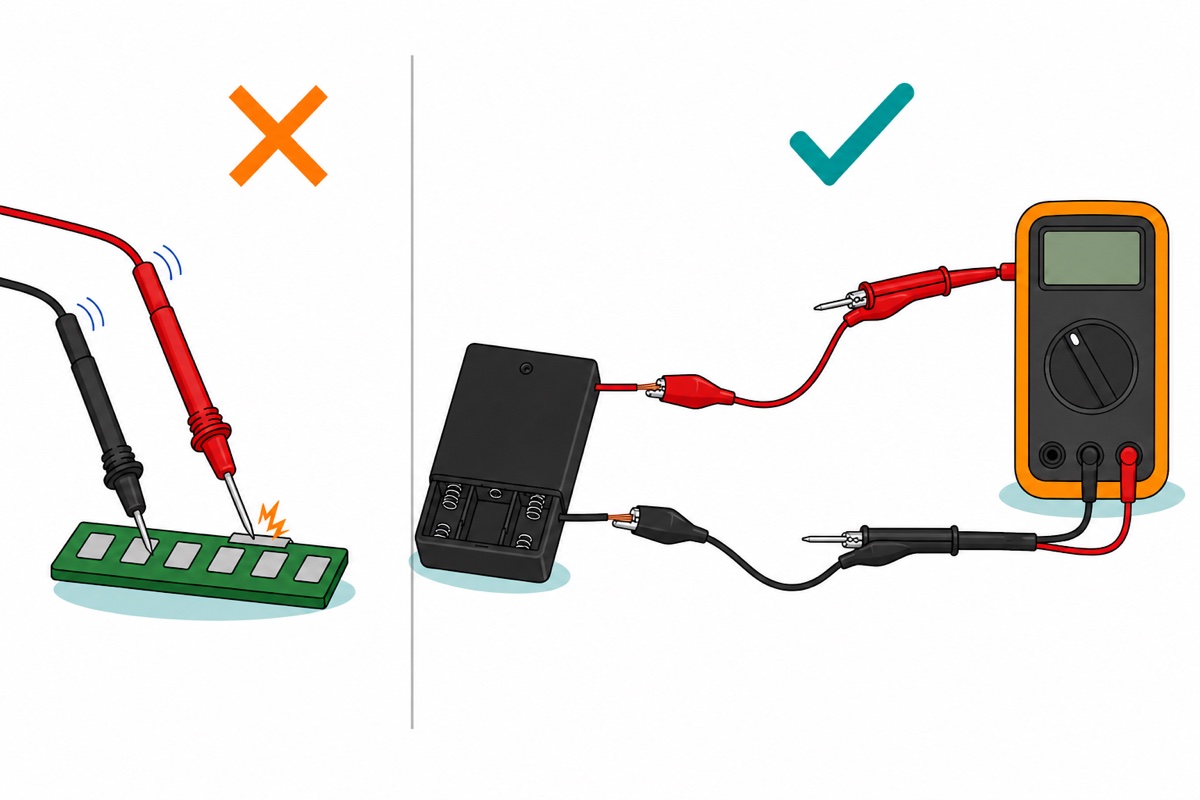
How do you read a battery pack under load?
Four alkaline AA cells in series at 1.5 V nominal make a 6.0 V pack. Set the XL830L to its 20 V DC range — the smallest DC step above a fresh pack’s 6.4 V, so the one with the most digits; our multimeter guide covers the rest of that dial, and the 18650 pack guide covers lithium, where numbers and safety rules both differ.
Here is why the clips matter. An open-circuit voltage tells you little: the XL830L’s DC voltage input is about 1 MΩ, so a 6 V pack pushes only about 6 µA through the meter — nothing is dropped inside the cells and even a tired pack reads healthy. What ages is internal resistance. A fresh alkaline AA sits at roughly 0.15–0.3 Ω, so four in series still make a pack of well under an ohm; as the chemistry is spent each cell climbs, and a tired set adds up to 2 Ω or more. At 2 Ω a circuit drawing 200 mA burns 0.4 V inside the batteries the moment the load starts, and that drop never appears unless the meter is watching while the circuit runs. Two clip leads leave it watching, both hands free to work the switch.
That turns an impression into a number. Read the pack with the load off, switch the load on, read it again, and divide the difference by the current the circuit draws: 6.1 V falling to 5.7 V at 200 mA is 0.4 V ÷ 0.2 A = 2 Ω of internal resistance. Do that once on fresh cells and you own a baseline for that pack, and repeating it later is how you tell a dying battery from a fault in the circuit it feeds.
| What the meter shows | What it means |
|---|---|
| 6.4 V or above, no load | Fresh alkaline cells, about 1.6 V each |
| About 6.0 V, no load | Alkaline nominal — in service, plenty left |
| 4.8–5.0 V, no load | Either a NiMH set at its 1.2 V-per-cell nominal, or an alkaline pack well spent. A freshly charged NiMH set rests higher, nearer 5.5 V |
| 3.6 V or below | 0.9 V per cell — alkaline flat by convention |
| Drops several tenths the moment the load starts | High internal resistance: tired cells, or a poor spring contact in one bay |
How do you clip a bare-wire sensor into a breadboard?
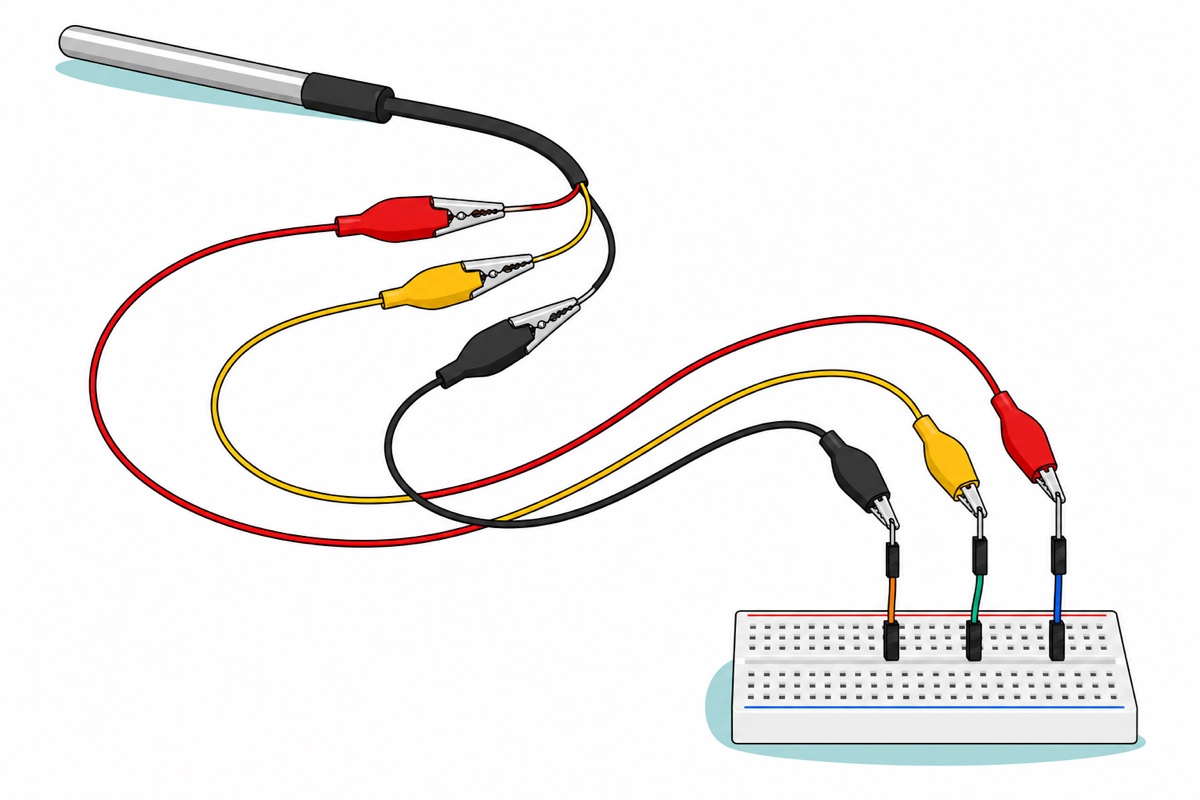
The waterproof DS18B20 probe is the classic case: a stainless steel tube on a black cable ending in three bare tinned wire ends — red, yellow, black — with nothing to plug in anywhere. Three crocodile clips get it onto a breadboard in a minute and off again with nothing to undo.
| Sensor wire | Function | Clip colour | Far jaw grips | That jumper goes to |
|---|---|---|---|---|
| Red | VCC, 3.0–5.5 V | Red | Male-to-male dupont pin | Breadboard + rail |
| Black | GND | Black | Male-to-male dupont pin | Breadboard − rail |
| Yellow | DATA, 1-Wire | Yellow | Male-to-male dupont pin | A free numbered row, shared with your board’s data pin |
Two things catch people out. The clips hold the sensor, they do not replace any of the circuit: the DS18B20’s 1-Wire data line still needs its 4.7 kΩ pull-up between DATA and VCC, or the bus never idles high and no reading comes back. And keep the three jaws well apart — the boots are bulky, and two leaning together across a power rail is a short you will not see. Once the layout settles, solder it — our header soldering guide covers that.
Common mistakes we see
Forcing a jaw into a breadboard hole. It will not fit, and pushing splays the spring clip inside that tie point so it never grips a jumper again. Use a male dupont pin.
Clipping two jaws onto adjacent legs of one part. A transistor’s legs are on 2.54 mm centres and the boots are far wider, so the clips touch and the short is silent. Move one connection out to a jumper first.
Letting a jaw close on insulation instead of metal. The jaw shuts on whatever is between its teeth, and from above a clip that has slipped onto coloured PVC looks exactly like a good one. The meter then reads OL or a few wandering millivolts, and the battery gets the blame. Look down the jaw before you power up: bare metal has to be visible between the teeth. Enamelled magnet wire is the same trap with no visual cue at all — that coating is a varnish the teeth will not break through, so scrape the ends bright first.
Carrying motor or charging current through clip leads. The bottleneck is the crimp and the jaw contact patch, not the copper. A warm boot is the warning; a clip that has arced never grips as well again.
Clipping on with the circuit already live. Attaching is the one moment a jaw swings free and can brush the node next door. Switch off, clip, switch on.
FAQ
What is the difference between a crocodile clip and an alligator clip?
None — the same spring-jaw connector under two regional names. “Crocodile clip” is standard in Malaysia, Singapore, the UK and Australia; “alligator clip” is American. Suppliers list the same item as crocodile clip wires, alligator clips or crocodile wire — search both.
Can I plug a crocodile clip into a breadboard?
No. A tie point is a spring slot for a 0.3–0.8 mm lead on a 2.54 mm grid, and a jaw is several millimetres wide — it cannot enter one hole and bridges three or four laid flat. Push a male-to-male dupont jumper into the board and clip onto its free pin.
How much current can crocodile clip wires carry?
Signal and test currents — a couple of amps briefly at most. The 22AWG copper is about 53 mΩ per metre, so a pair of 35 cm leads adds roughly 37 mΩ, a 37 mV error at 1 A. The crimp and jaw contact patch are less predictable still, and heat appears there first.
Can I use crocodile clip leads on mains voltage?
No. They carry no IEC measurement-category rating: thin insulation, exposed jaw metal. Mains work needs equipment marked for the category, and the training to go with it — the XL830L’s own body carries a CAT II 600 V marking; the clip leads carry nothing. Keep crocodile clips on low-voltage DC.
How do I attach crocodile clips to my multimeter probes?
Clamp the jaw around the bare metal shaft behind the probe tip, so the teeth bite metal and not plastic. Do it with the circuit off, red on positive and black on negative, then power up and read. Check the jacks first — black in COM, red in VΩmA. A meter left in the 10ADC jack is close to a short circuit between the two clips, and the XL830L marks that jack 10A MAX UNFUSED.
Last updated August 2026. Stuck? Chat with us on WhatsApp.

Pingback: How to Test a Capacitor With a Multimeter
Pingback: micro:bit V2 School Projects: What's Already on the Board