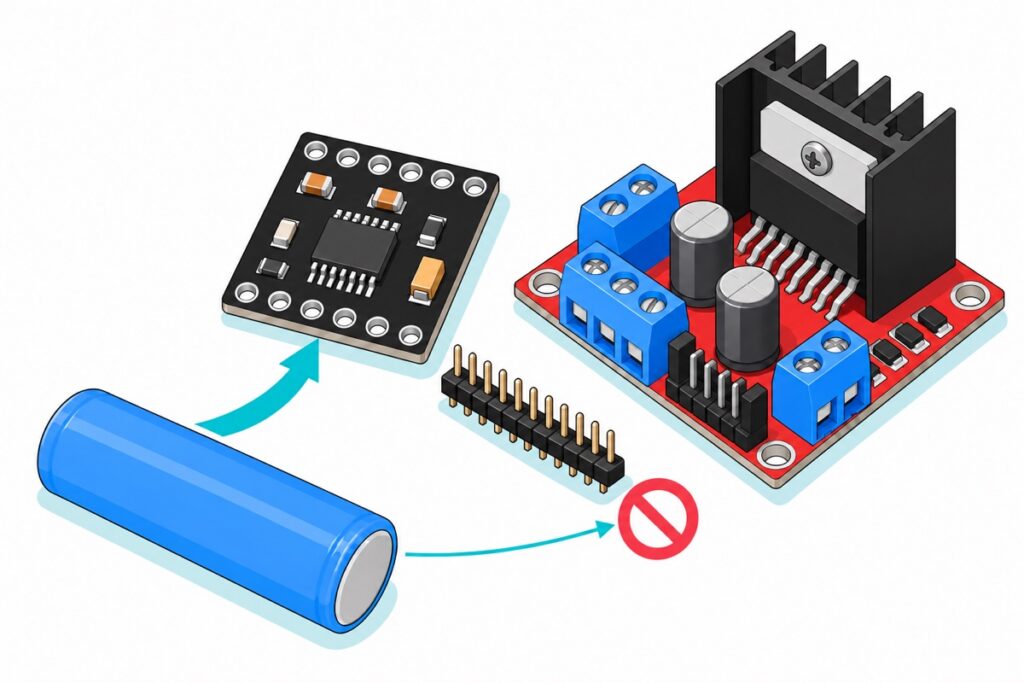
The one wiring mistake that silently disables your TP4056’s protection, plus charge-current resistors, LED meanings, the real 4.2V and 2.4V thresholds, and honest current maths for boosting a single 18650 to 5V.
Just bought a cheap multimeter but the symbols on the dial mean nothing to you? There are only three modes you really need for Arduino work — DC voltage, continuity and Ohm. This guide has a dial symbol table, a range-picking table for every kind of measurement, and the reason the 10A jack can destroy your meter.
Everything you need to run an HC-SR04 ultrasonic sensor on an Arduino: the four-pin wiring table, a runnable pulseIn() sketch, and why the distance maths divides by 58 — plus the range, beam-angle and 3.3V limits that catch out real projects.
Three parts — an LM393 rain sensor, an Arduino UNO and an SG90 servo winch — and your model clothesline pulls the laundry in the moment rain is detected.
A 180° servo moves to the angle you command and holds it; a 360° (continuous) servo cannot hold an angle at all — its write() value controls speed and direction instead. A 270° servo is simply a positional servo with a wider sweep. All three look identical from the outside, so below is a 30-second […]
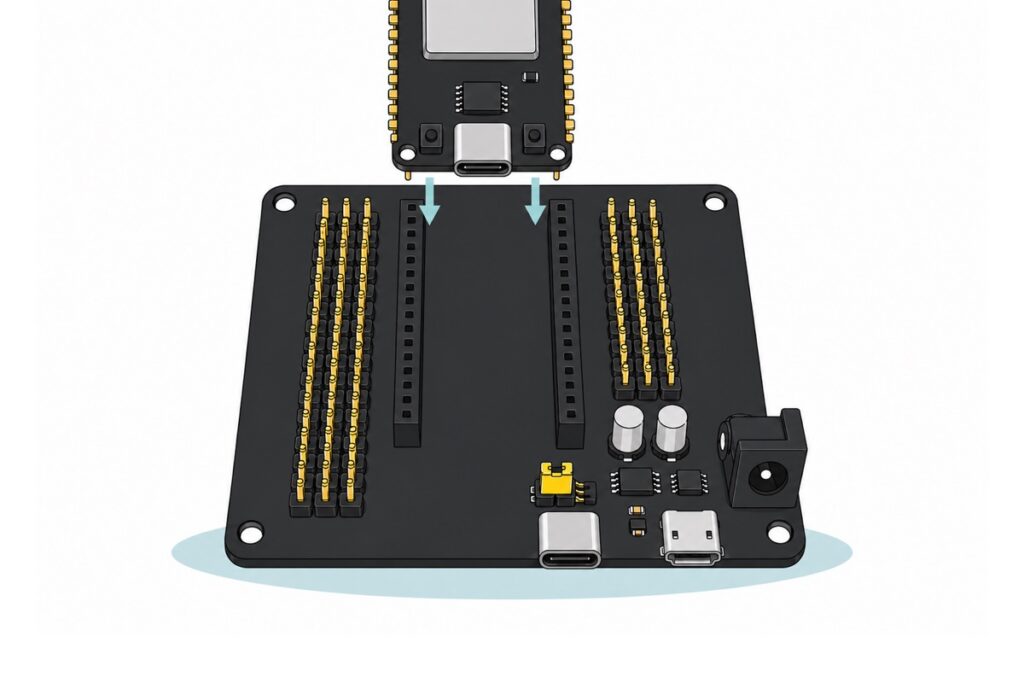
If your ESP32 is not detected in Arduino IDE, the cause is almost always one of three things: a charge-only USB cable, a missing CH340 or CP2102 driver, or a board that needs its BOOT button held during upload. Swap to a proper data cable first — that one step fixes over half the cases […]
To solder header pins, push the header’s long side into a breadboard, sit the module on top, then touch a 350 °C iron to both the pad and the pin for 1–2 seconds while feeding solder into the joint — about 3 seconds per joint. A good joint looks like a shiny little volcano, and 15 […]
Your LM2596 buck converter ships at a random output — often 9V or 12V — and that is normal, not a defect. To set it to 5V, connect a 7–12V input to IN+/IN−, probe OUT+ and OUT− with a multimeter set to DC volts (the 20V range on manual meters), and slowly turn the trimmer […]
The Data Logging Shield gives an Uno a full-size SD socket and a DS1307 clock. Here is the wiring for a waterproof DS18B20, a compiled sketch that writes timestamped CSV rows, and the two mechanisms that decide whether your log survives a power cut: the SD library’s 512-byte RAM buffer, and the DS1307’s CH bit.
The GY-906 MLX90614 does not measure a point — it averages everything inside a 90° cone, so the spot it reads is twice as wide as its distance. Here is the wiring, a compiled sketch, the emissivity fix for shiny metal, and why this is not a fever thermometer.